Archives For Step 2 – Advertising Your Job

Building a strong candidate pool is one of the hardest parts of hiring. In order to build a candidate pool, you need to advertise your job.

Using a recruiter can be a great way to save you time, energy and resources when hiring. We all know it’s not a quick (or easy) process, but sometimes you just need a little help. Is using a recruiter hurting you more than helping you? That scenario is definitely possible. Keep reading to figure out if your recruiter is a pro or a con.

using a recruiter hurting Quiet, monotone, unenergetic, negative, mean and even down right rude.  These are the perfect adjectives to describe the next Bond villain but maybe they aren’t perfect adjectives to describe your recruiter. If the aforementioned adjectives could be used to describe your recruiter, it’s highly likely using a recruiter is hurting your chances.

As a candidate who is interested in a position within your organization, I want to work with a recruiter who I wouldn’t mind seeing in the office every day. If your recruiter is kind, friendly, helpful and really organized, you can bet they are helping you hire. Remember, job candidates are screening you too. You need to put your best foot forward from the very beginning.

A recruiter within an organization can wear many hats, but their number one job is to present you with qualified candidates.  The recruiter was hired to hire!  Through a set of processes, they present qualified candidates to the decision makers of the company. There are a number of pro tips and tricks we’ve compiled over the years we’ve been helping small and medium businesses hire.

Let’s look at the things that will hurt you more than help you:

  • Your recruiter has a bad attitude or bad vibe
  • The recruiter isn’t excited about the company or position
  • The recruiter isn’t selling the opportunity
  • The hiring managers don’t trust the recruiter’s decisions
  • The hiring managers aren’t seeing qualified candidates
  • There is no recruiting process or organization
  • The recruiter isn’t following up with candidates

If any of those sound familiar to you, using a recruiter is hurting you when trying to hire. But don’t worry too much. Using a recruiter isn’t always bad, and it can actually be extremely efficient and helpful!

Here are the things that will making using a recruiter helpful to your organization:using recruiter helping

  • The recruiter answers the phone as if they are the one interviewing
  • The recruiter always has a positive attitude
  • The recruiter presents the company in a positive and professional manner
  • The recruiter keeps detailed notes in a database
  • The recruiter is excited about the job and company
  • The hiring managers trust the recruiter’s decisions
  • The recruiter gives the candidate feedback
  • There is an outlined and consistent process including follow up

Does that sound familiar? We hope so. Because that means your recruiter is absolutely helping you make the right hire!

Using a recruiter is something many people are on the fence about because they don’t want to find themselves resonating with the first list. The question isn’t necessarily whether or not you should use a recruiter, because clearly they can be very helpful, but it’s about finding the right recruiter. You want one that’s going to help, not hurt. They’re out there. You just have to be selective.


This is the third of a three-part series that’s designed to help you answer the question “why is it so hard to hire an employee?” 

We’ve addressed what may be the problem if no one is applying for your job and why qualified applicants aren’t applying, but what if you have plenty of qualified candidates applying? You might be thinking, “what’s the problem?” The obvious answer is: There is no problem with having plenty of qualified candidates. The problem comes when you have no follow up.

What do I do if I have plenty of applicants but no follow up?

Don’t kick yourself for not following up. It happens. There are many reasons why you may find yourself lacking in this department.

no time to hire an employeeMost small- and mid-sized employers wait to hire an employee when there is enough business to support a new employee. That means that everyone in your office is currently working at capacity. Everyone is slammed handling customers, orders and other immediate tasks. That doesn’t leave anyone with the time needed to properly hire an employee.

Other times, we find ourselves hiring in “emergency mode.” When people take new jobs, retire or get fired suddenly, you need someone quick. But you also need to get their work done. No wonder you don’t have time to follow up; you’re currently doing two jobs!

Maybe you’re not slammed for time but there is no clear delegation of work responsibility for following-up with the top candidates. The President, Owner or manager got the ball rolling, but is too busy to see to the details. Who takes it from there?

Or perhaps it’s just too much to handle in additional to the regular work load. That’s possible. Especially in the case of smaller companies that might not have a dedicated HR staff or recruiter.

It takes a lot of time to hire an employee, so it’s certainly not something you can “just squeeze in.”

hire an employee phone interviewConsider this: It takes 30 to 45 minutes to conduct a phone interview. Let’s say you want to conduct 10 or 12 phone interviews so you can have 3 or 4 quality candidates for face-to-face interviews. That’s 540 minutes or 9 hours just to do the phone interviews. Wow! No wonder you don’t have time.

That 9 hours doesn’t include the time it takes to identify the best applicants, or the time it takes to send emails, set appointments, leave voicemails, or deal with the interruptions when the candidates call back. And all of those steps must be taken. That’s a lot of time!

So what do you do? You either work crazy hours, shift priorities or you can ask for help. There is nothing wrong with reaching out for help, but it’s best not to wait too long to do that. The best candidates don’t stay on the market for long.

As soon as you recognize that you don’t have the necessary time required to hire an employee, take action to remedy it. Either shift priorities or reach out to someone that can help bear some of the burden. We don’t recommend the ‘work crazy hours’ option.

For more information read Part 1 and Part 2 of this series.

If you are having this problem now, feel free to reach out to us. We’re pros at helping you find the right person for your job.


This is the second of a three-part series that’s designed to help you answer the question “why is it so hard to hire an employee?” 

Last week, we addressed why no one was applying for your position, but that’s not everyone’s issue when it comes time to hire an employee. Perhaps people are applying, but you’re simply not getting well-qualified applicants. Or maybe you’re being inundated with entirely too many applicants. Let’s dive into why you might be experiencing these problems when hiring.

Why isn’t anyone well-qualified applying for the position?

You’ve been advertising the open position in all the right places, and candidates are responding. But when you review the resumes, none look attractive.  None of applicants meet all the qualifications and requirements you set.

Unqualified Concept

You don’t want to waste time on interviews with people who are unqualified, overqualified, or don’t look like a good match for the company, so you don’t follow up with anyone. That’s understandable, but it’s not going to help you hire an employee.

It is reasonable (and advisable) to be worried when none of the candidates who apply appear to be a good fit.

Why does this happen? Here are a few possibilities:

  • Your job description doesn’t accurately reflect the work or qualifications you expect. Candidates only know what you tell them so give them the information they need to know if they are well-qualified for the job.
  • The expectations for the job changed between the time you advertised and the time you start screening. If this is the case, you need to revise the job advertisement and accept new applications. Changing expectations during the hiring process will lead to frustration for both potential employee and employer.
  • You are looking for a flying mermaid; a rare creature indeed, and likely one you will not find. The combination of experience and knowledge, duties and responsibilities you set are not realistic. To be attractive, the job must be doable. Just because the founder or owner did all that stuff at some point – doesn’t mean an employee can or will.

It is hard to admit it when we’ve experienced any of these problems. It could feel like a personal failing. Admitting to a mistake is hard.

The first step in solving the problem is pinpointing the issue. If you think you’ve experienced one of these challenges, take a step back, take a deep breath and remember there is a solution. In many of these cases a little research or competitive intelligence can go a long way to solving the problem and moving forward with a fresh start.

Why are so many people are applying for this position?

Some employers find themselves overwhelmed by the candidate response. When you have too many candidates to review, it’s overwhelming, and hard to figure out how to identify the best candidates. When that happens, you may find yourself procrastinating reviewing any at all because it’s human nature to put off things that seem daunting.

Before we figure out how to eliminate this problem, let’s figure out how you got to it in the first place.

hard to hire an employee

There are a few circumstances that typically lead to a barrage of resumes.

  • If the position you are hiring for is entry-level or lower skill level, you will inevitably get more applicants than when you are hiring a more senior-level employee.
  • If the position is very attractive – the employer has a great reputation, competitive wages and benefits, and an excellent employment value proposition — you’re going to get a lot of applicants. Pat yourself on the back. You deserve congratulations as that is no easy task and deserves recognition.

If either of those are the case, you need to be prepared to see a lot of applicants. If you’re not prepared, it’s easy to feel overwhelmed and start procrastinating. That is absolutely not how you want to feel when trying to hire an employee. If there is no screening system, plan of action, or objective hiring criteria in place, you’re probably going to feel that pain. But don’t worry. There are things you can do.

If you’re feeling the pain from either of these problems, you might need some tools and coaching to get you over the hump. You also may need a system that allows you to quickly identify the best qualified talent, without reading every application because we know the pain of reviewing applicants. 

If you want to learn more read Part 1 or Part 3 of this series.

This is the first of a three-part series that’s designed to help you answer the question “why is it so hard to hire an employee?” 

It happens regularly; the president, CEO, owner or sales manager calls and asks if we can help them with a hire. Often they have tried to do it on their own, but are having a tough time. They ask, “Why is it so hard to hire an employee? Can you help me?”

There are many factors involved when it comes to hiring, so before we say “yes, we can help,” it’s essential to understand what is truly happening.

Here are four reasons you might find it hard to hire an employee:

  • Hardly any candidates are applying
  • Candidates are applying, but none of them are well-qualified
  • So many people are applying that it’s overwhelming
  • Plenty of qualified candidates applying, but you aren’t following-up

There are many reasons that you can experience any of these four problems. Understanding the problem is the key to finding the right solution.

We’ll address each of the four reasons in this series, but for this post, let’s address the first reason you’re finding it hard to hire: no one is applying.

Why isn’t anyone applying for the position?

You’ve been advertising the job and hardly anyone is applying. That makes it really hard to hire an employee. You’re right to be worried, but what do you do? There are a few things.

hire an employee newhire

First, let’s look at expectations.

Fewer people are going to apply in 2014 and 2015, than in 2009 and 2010. During the Great Recession there were a lot of people on the job market and very few openings. That means, every job that was open during the recession got many applicants based on pure numbers. But times have changed, and I am not complaining! There are more open jobs and fewer candidates. The competition for talent is heating up, and most jobs are attracting fewer applicants. Your new smaller candidate pool may simply be a byproduct of this change, so it’s important to adjust your expectations.

Next, let’s look at the job.

Is the job title unusual or uncommon? In the world of internet job board advertising, candidates find jobs by searching keywords. If the job title is unusual, or doesn’t reflect the duties or salary being offered, appropriate candidates might not be finding the ad. If no one is finding the job, certainly no one will be applying.

Is the job competitive in the marketplace? If the salary, wages or benefits offered aren’t competitive with those offered for similar positions, you’ll see a very small number of applicants. Applying for jobs is time-consuming and many applicants focus their efforts on applying for the best jobs they find. Why spend the same time applying to three very similar jobs if one of them is only offering up 70% of the salary? Pro tip: the top talent won’t apply for jobs that don’t offer competitive compensation.

Does the advertisement highlight the best aspects of the job? Sometimes the available job is a great job at a great company, but the advertising copy doesn’t do either justice. Make sure you put your best foot forward.

Now, let’s look at the people.hire an employee 2 new hire

How many people out there are truly qualified for this job? Are we simply dealing with a scarce candidate pool? For example engineers with many years of experience are going to be tougher to come by than entry-level account managers.

Did too few people see the job posting? If the advertising was not adequate to build a candidate pool, it’s possible not enough of the right people even know about the job. (Hint: you might need to spend more on advertising.)

Do any of these challenges sound like things you’ve experienced? If so, maybe you need some hiring help. Don’t worry. You’re not alone and we can help.

If you still aren’t thinking, “yep, that’s exactly the problem I’ve been having,” stay tuned for part 2. We’ll take a look at the other reasons you may be finding it hard to hire an employee, and give you some tips to make it easier along the way.

Go to part 2 of this blog post to read more on this topic.

Mad computer

In the digital age, consumers have more information available than ever before. One increasingly popular source for such information is opinion and review platforms with non-professional/user-generated content. Whether it’s ranking a restaurant (Yelp), movie (IMDb), book (Goodreads), or even college professor (RateMyProfessor), it has become more and more frequent for everything and everyone to fall under anonymous Internet raters’ scrutiny.

And while much has been written about employers’ ability to use social media to check candidates’ backgrounds, the web has also enabled job seekers to research prospective employers based on past and current employees’ reviews. These employer reviews can play a major impact on the recruiting process, whether positive or negative, and are becoming increasingly important to track when looking to a make a hire.

Where are jobseekers going for Employer Reviews?

The two largest employer review websites currently are Glassdoor and Indeed. While smaller employers could have zero to a few dozen reviews, large employers, such as Coca-Cola, have over a thousand. On both sites, current and former employees rate companies on a 1 to 5 star scale.

Glassdoor allows reviewers to get a little more specific and asks reviewers to rate companies’ Culture & Values, Work/Life Balance, Senior Management, Compensation & Benefits, and Career Opportunities. Both sites allow reviewers to leave comments to accompany their rating, which is frequently where the most insightful information resides.

When a possible applicant uses these sites to research an employer and sees an overwhelming number of negative comments, their desire to spend time applying for that position shrinks. No one wants to work for a bad employer.

Do these reviews really have an effect on recruiting?

How frequently have you seen a restaurant proudly displaying their high Yelp or TripAdvisor rank? Some service sites put enough credence in user reviews that they use them for quality assurance.

For example, Uber, an increasingly popular transportation start-up does not allow drivers who fall below 4.7 stars to continue to drive under the company name. While goods and services providers have known for a while that online review sites affect business, when it comes to recruiting, many small- to mid-sized companies may overlook online reviews’ influence on attracting applicants and hiring people to fill positions.

When consumers turn into candidates, they don’t stop utilizing the web for information gathering. Time Magazine reported that nearly half of employees polled in 2013 said that a company’s online reputation matters as much as the job offer.  For personal evidence- all three of the most recent employees at NewHire (myself included) looked at online employer reviews during our job hunt. Finally, one possible extra perk keeping high reviews: saving money. Most candidates are willing to accept a lower salary if company reviews are favorable.

In their 2013 Candidate Behavior Study, CareerBuilder discovered that 67% of the over 5,500 job seekers polled said they would take a lower salary at an exceptionally reviewed employer online. That’s a lot of people.

Employer reviews are key to making good hires at the rate you want. So now that you know how important they are, what can you do about poor reviews? Stay tuned for part 2 and I’ll let you know.

keywords for recruiting

Source: http://www.flazingo.com/


It’s no secret; one of the toughest parts of recruiting is finding the right candidates, and helping them to find you. According to a recent report from the Bureau of Labor Statistics, there were 4 million open jobs in March of 2014! With all those options for candidates, it’s important to do everything in your power to make the job you’re hiring for stand out in the crowd. Using strong keywords in every recruitment ad is one way to make it easier for the right candidates to find your ad. So how do you know which are the best keywords for recruiting the type of person you want?

The goal of an effective recruitment ad is to help candidates who are a good match for the open position find your ad and apply for the position.  There are several factors other than keywords which make an ad successful. You can read the keys to successful recruitment advertising in our other blogs here.

Today, candidates use a variety of websites to find open jobs.  The number of job boards and search options available to candidates continues to increase. Candidates use job boards (Indeed and CareerBuilder etc.), search engines (Google, Bing and Yahoo) and social media (Facebook, LinkedIn and Twitter).

Including keywords in a recruitment ad is a little like doing SEO-lite. Using keywords for recruiting will improve the likelihood that the ad is findable on the web. Keywords are like a homing beacon, attracting the right candidates to the open position. So what are the best keywords for recruiting to include and how should they be used?

Keywords are the common words or phrases that provide information that is most important to candidates you want to attract – don’t use company jargon or esoteric, cryptic, or otherwise confusing terms. Your top candidates will focus on what’s important to them when they’re searching, and the more keyword categories you include the more you increase your chances of reaching those candidates.

Keywords fall into several different categories that include all the primary aspects of your open position: Job Title, Location, Salary range and perks, Industry and product specifics are all important. Put yourself in the shoes of your ideal candidate; imagine how they will be searching the web to find their next job.

The job title is super-duper important. If you use the wrong job title, the right candidates might not find the ad. Worse yet, the right candidate might not identify the job as appropriate to them. For example if you call the job “Customer Service Representative” but expect candidates to be able to share accounting expertise with customers when providing service – you might find that you aren’t able to build an appropriate candidate pool. Once you’ve decided on the appropriate job title you can include a few variations peppered throughout the ad text.

Inducing industry information is also important. All sales jobs are not the same. After all, selling specialty software to legal firms might be a tad different than selling cars on Parkway Avenue, or selling capital equipment in the manufacturing sector. Include the industry of the company, and the types of products involved. Find ways to get that information into the ad more than once.

Salary, benefits, and perks count too. You might be surprised how often candidates search for “sales jobs with company car”. Be sure to tell the candidates what’s in it for them, be as specific as possible. You might even find two places to include this information in the ad, for example include compensation information once in a sentence in the first paragraph of the ad and once in bullet point list later in the ad.

Geography also matters. Does this position require the best candidate to be at your work site or office? At a client work site? At their home office? Travel to a different location each month? While big box national retailers may have openings in every city – smaller employers likely have a more specific work location in mind. Let candidates know where they will be expected to work. And tell them twice!

Repeat keywords a few times in the recruitment ad text. But be careful! Don’t just repeat the keywords again and again at the bottom of the ad. Instead use the words in context, a few times. Use similar words, variations, synonyms and common abbreviations to add variety.

Keywords should be included in your recruitment ad to help candidates find the dream job you are advertising. Use keywords in your recruitment ad to grab the attention of your ideal candidate AND to help them find the job using job boards, or by Google searches. Use keyword several times through out the recruitment ad to be sure that where ever your ideal candidate is searching for their dream job – the job ad they see will be the one you are recruiting for. Lastly, if you are planning to share the job by social media, don’t be afraid to use the #hashtag (#hiring #location #industry #jobtitle), it can only help get your job found.

Follow along as we hire for open positions at NewHire.

We’ve been steadily interviewing for a couple of different positions at NewHire, but now the urgency of the need has increased. We have you, our wonderful clients, to thank for that. So, thank you!

We thought it might be interesting and informative for you to follow along as we hire (and we thought you may know someone who would be a good fit). We are currently in the process of building a candidate pool for several different roles. Here are the jobs we are looking to fill:

Staffing Coordinator:

As you know, Staffing Coordinators deliver the NewHire recruiting process to our clients. We have an internal, written job description which details reason the job exists, the duties, responsibilities and rewards of the job. Actually we have three of those job descriptions, because each Staffing Coordinator wrote their own job description. Now we have a NewHire application here. 

Account Manager:

This is a sales role. The job description focuses on learning NewHire products and services and learning our clients’ needs and wants. Our goal is develop Account Manager into recruiting experts. We distinguish the role from the job title “Sales Representative” because Account Managers don’t cold call. They do go out on sales calls, sell over the phone, network, attend trade shows, do demonstrations, write blog posts and provide post-sales support to clients. We are looking for two people and you can see the NewHire application here.

Administrative Reception:

This is our entry-level position and we have promoted most of our current staff from this role into others in the company. We look for the “best available talent” measured by intelligence, behaviors, motivations and aptitude. If you know a recent college grad interested in a growing web-based software and service company, please send them here.

Building a candidate pool is no easy task. It’s important to advertise to the right people, get a good pool to choose from and then screen them to see who you want to interview.

Each process will rely on NewHire to advertise, source and screen candidates. We’ll phone screen the people who are the closest fits and give assessments to the best of the phone screens.

Follow our blog for more updates on the process. We look forward to introducing you to the newest members of the NewHire team once we have finished building a candidate pool, screened our candidates and selected the best person for the job, because we believe every job deserves the right person.

Today’s jobseeker landscape has vastly changed from how it appeared only a few short years ago. Job boards like HotJobs and Monster.com have all but disappeared from our regular referral sources, while new boards like Indeed have exploded in usage. Job seekers tend to sway in what boards they favor like teenage girls to the newest boy bands; what was trendy four years ago is no longer “in” and what is popular now might not be in the future. The importance of social media as a source for jobs seekers is reflected in LinkedIn’s steady presence on our lists of preferred referrers.

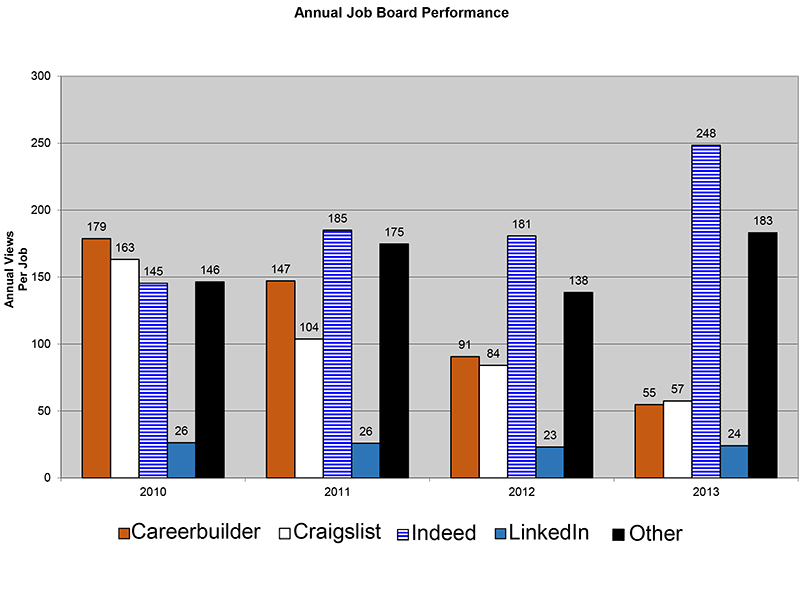
During the past four years, Indeed experienced explosive growth, nearly doubling the number of annual job-seeker views per NewHire job since 2010. CareerBuilder and Craigslist have declined steadily. And for the first time ever in 2013, Craigslist edged out CareerBuilder. LinkedIn remains a very steady board, providing a stable number of job- seeker views to NewHire jobs each year.

CareerbuilderG1ReferralsPerJob-1- Large Key

In 2010 CareerBuilder was the top performing job board with Craigslist in a clear second place. Today the lay of the land in recruitment advertising is changed. Indeed is the clear winner.

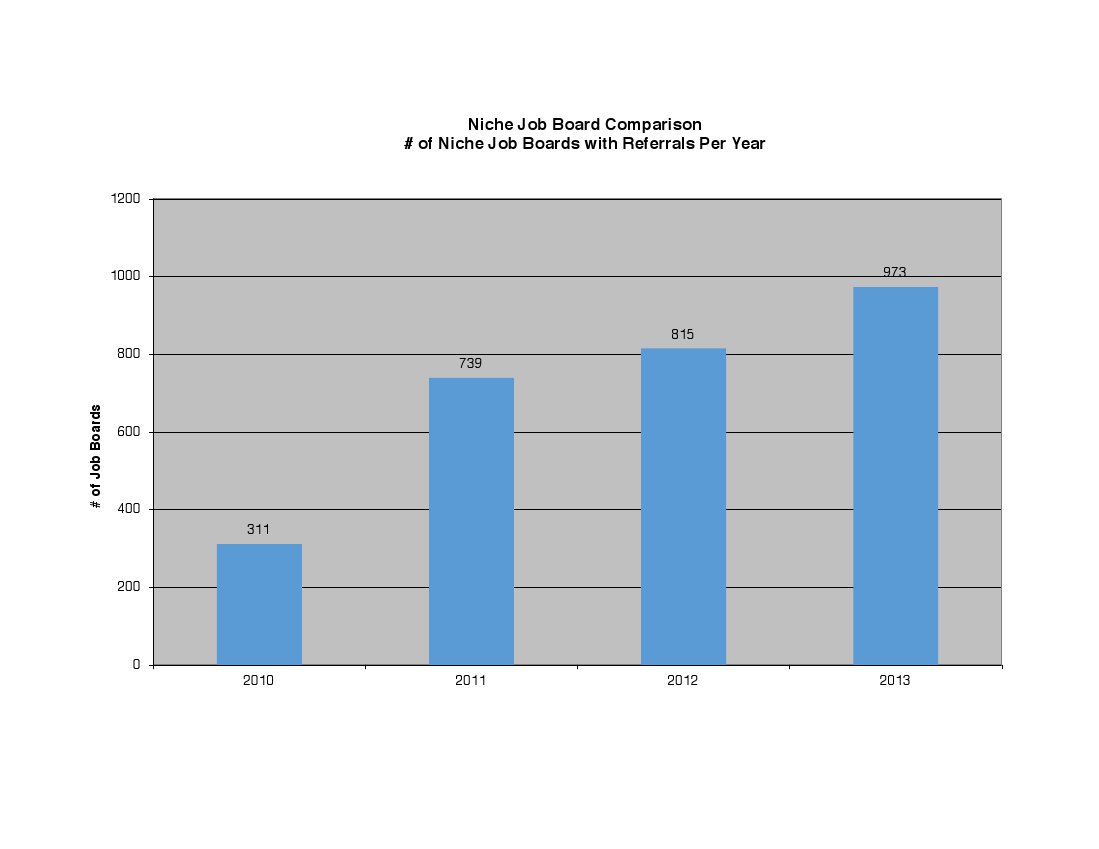
But there are other players that can’t be ignored. In second place, receiving the silver medal, is a category we call “other”. It is made up of 100s of Niche job boards, employer careers pages, emailed jobs and Google searches. This category is like the relay team – energizing the recruiting landscape with many less well known players. Together these sites play a key roll in attracting candidates. Is next year’s big winner hiding in this category? We don’t know, but stay tuned because as surely as daffodils bloom in spring, the recruitment advertising market will change in the coming four years.NicheJobBoards_NumberOfBoardsPerYear

The rise of these niche job boards is part of the reason why things are not completely doom and gloom for CareerBuilder. While it may not contribute as many candidates as Indeed, it does play an important part in the “spider web” effect of spreading posted jobs to its partner sites such as Headhunter and MoneyJobs. Combined with our highest application rate of 38%, there are still compelling reasons to keep CareerBuilder a part of your recruiting process.

More about the data and how we get it:

As a provider of applicant tracking software and recruitment advertising services to companies with 1000 or fewer employees, NewHire is in a unique position to provide independent data on job board performance.

In the past, we’ve blogged about the importance of Indeed as a source for candidates – the people who actually apply for the job, not just job seeker views. In the data shown here we’ve expanded– going back four years – to get a more general look at how both Indeed has risen up – and CareerBuilder and Craigslist have tumbled.

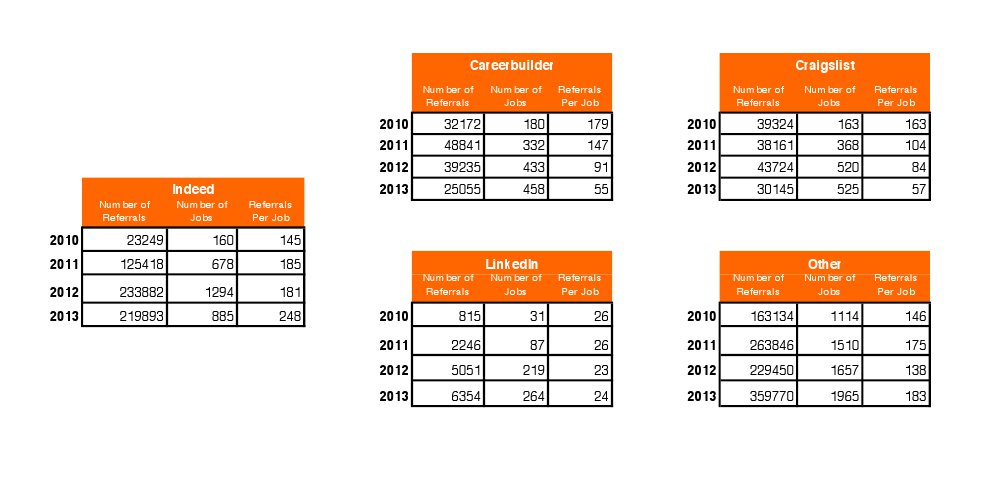
Below is a table showing the detailed results of this four year effort.

table info reformatted_ecantave

First – let’s look at the number of unique NewHire jobs each year that received views from key job boards including CareerBuilder, Craigslist, Indeed and LinkedIn. We’ve also included the category of “Other” as a catch all for many smaller niche boards and our own NewHire Job board. Every NewHire job with a job-seeker page view sent by one of these boards was counted.

As the employment market has steadily gained steam, you can see the number of jobs advertised on each board has steadily increased.

So, with increasing number of jobs advertised, you might think our referral numbers also show a corresponding increase, correct? Not according to the data we examined. CareerBuilder shows a small gain before sliding in 2012. Craigslist, on the other hand, rises through 2012 and then falls off in 2013, while Indeed explodes in popularity, growing each year. The only job board to actually follow the pattern we expected is LinkedIn, which showed modest increases in traffic each year as more jobs were added. Finally, the last column of the table shows the annual number of referrers per job. CareerBuilder and Craigslist lost the most ground, and Indeed gained the most over the past four years.

What does this really say about Job Board performance?
• Make sure your job is featured on Indeed
• Don’t discount advertising on other boards as they bring views, candidates, and links that all help drive the category called “other”.
• Take advantage of the interconnectivity of the web and social media sharing to help us help you get the right candidates!

Stay tuned as we delve further into that mysterious “Other” category in future blogs!

iStock_000007455150Small

Having experienced thousands of job openings and millions of candidates at NewHire, one lesson is clear: Every recruiting project moves from the “ideal world of the job description” to “the real world of the people actually interested in your job.”

Perfect candidates are an extremely rare breed. This Harvard Business Review article (link: http://blogs.hbr.org/2013/01/dont-hire-the-perfect-candidat/) calls them “purple squirrels.” We tend to call them “flying mermaids.” However you think of them, there’s nothing wrong with finding the perfect candidate — if you can do it in the time frame required to meet your business objectives. When you find a candidate like this, think of it as a happy accident.

As in most of life, timing is everything. The bigger your hurry, the more compromising you must do. The higher the stakes, the more careful you feel you must be. Let’s look at two real-life scenarios to illustrate what we mean:

Scenario 1.

You have an opening for a sales representative (I know… you always do) on your team of five. People are a bit stretched covering the open position, but not impossibly so. Your Sales Manager is spending measurably less time coaching and more time selling, so this hurts the overall sales effort. Given the cost of the hire, the initial training and a significant ramp-up time, you’re looking at an investment of $50,000 to $60,000. You’ve seen six candidates who have been through a multi-step recruiting process, including a positive result on a sales assessment that you believe in. You’ve been at it for 90 days. Each of the candidates has significant pros and cons. Do you pick the best of the bunch or keep looking?

Scenario 2.

You own the business and it has been good, growing, and modestly profitable. You’ve been at it for six years and now you are thinking it’s time to bring in a General Manager or COO who will help you to the next level. You want to add more professional management experience to your organization. You want time to work on new products and spend more time with customers. People tell you that you’ll have to pay $110,000 to $130,000 to get the right person. Having mentioned your interest to a few colleagues, referrals are trickling in and you’ve met with three candidates. You liked one of them a lot, but she’s in demand and likely has other offers. Do you take the plunge and hire her?

Here are our answers:

Scenario 1: Pick the best of the bunch and get a sales rep hired.

Yes, it’s a significant investment and you want to get it right, but the cost of doing nothing exceeds the risk of hiring the wrong person. It’s difficult to calculate lost opportunity, but you know it’s there. Without a fully functioning sales machine it’s difficult to grow. Use 30, 60 and 90 benchmarks to measure whether your new hire is on the path to success. Keep sourcing, screening and interviewing candidates… there’s never a wrong time to hire a purple squirrel sales rep. Build the cost of sales rep turnover into to your annual budget so that you don’t fret every time a sales rep fails… it happens.

Scenario 2: Slow down! Back up and start over.

We are not opposed to “opportunistic hires,” but the business owner in this scenario has not spent any time clearly defining the role and responsibilities, nor have they thought about the behaviors and motivations that the GM or COO job would reward. What is the owner’s behavior profile? Should the new hire have the same kind of profile or should it be different, filling in leadership and management gaps. Would a hire coming from a large organization with a strong history of implementing corporate best practices be a good idea? Is the referral he liked, “the best available talent?” He doesn’t know WHO he doesn’t know, so expand the pool of candidates dramatically. Kiss a lot of frogs. It helps you identify when you’ve found your prince.

How many people do you interview for each position before you hire?


combinationSocial media can be a valuable tool in any small to mid-size company’s recruiting process. Not only are most sites free to set up, but they can also be a key source of finding candidates. In fact, 78% of recruiters reported to Jobvite that they used social media to make a hire in 2013 .

Here at NewHire, we are encouraging clients who utilize social media platforms to share their application on their own accounts. This can include both your company’s accounts and even your own personal ones. By sharing your open positions with those in your social media circle, it will help target individuals already connected to your industry and help draw new candidates to the opening. In the case of personal accounts, it will alert those in your life of the opportunity and involves one of the most important parts of getting a job: networking.

To share the application, follow these five steps:

1. Open your application

This can be done in NewHire by clicking “Dashboard” in the upper center of the page, choosing “View All Jobs” from the dropdown menu. Then select “View” under the “View Your Application” column for the job you’re interested in sharing. Alternatively, if the position has been posted on any job boards, you can click the “Apply Now” button to open your active application.

2. Find “Share/Save”

Once your application is open, you will see a grey box towards the upper right side of the page that says “Share/Save”. Move your cursor over the box to open the list of available social media sites.

3. Select the sites that you would like to use

The sites that people are most likely to select — LinkedIn, Twitter, Facebook — are shown by default at the top. However, there are over 90 sites to chose from, ranging from well-known to obscure. You can view the full list of options by clicking the small black arrow on the bottom of the box and scrolling down.

4. Craft your post or tweet

Once you click on any of the social media sites, you will be automatically forwarded to that site in a new tab where you will be asked to login if you are not already. From there, you will be able to edit the text that will accompany the post or tweet and add hastags.
LinkedIn Note: For sharing a position on LinkedIn, you must make sure that you are already logged in to your account in your browser prior to trying to click to share the position.
Twitter Note: Adding hashtags helps categorize your tweet and draw outside users to reading it. Popular recruiting hashtags include #jobs and #hiring. Other things you can include are the location (i.e. #Chicago) or the industry (i.e. #insurance)

5. Submit the post and wait for candidates

There you have it! If you have any questions or problems with this process, you can always feel free to call NewHire at 877-923-0054 for further assistance.