Archives For Job Boards

This is the second of a three-part series that’s designed to help you answer the question “why is it so hard to hire an employee?” 

Last week, we addressed why no one was applying for your position, but that’s not everyone’s issue when it comes time to hire an employee. Perhaps people are applying, but you’re simply not getting well-qualified applicants. Or maybe you’re being inundated with entirely too many applicants. Let’s dive into why you might be experiencing these problems when hiring.

Why isn’t anyone well-qualified applying for the position?

You’ve been advertising the open position in all the right places, and candidates are responding. But when you review the resumes, none look attractive.  None of applicants meet all the qualifications and requirements you set.

Unqualified Concept

You don’t want to waste time on interviews with people who are unqualified, overqualified, or don’t look like a good match for the company, so you don’t follow up with anyone. That’s understandable, but it’s not going to help you hire an employee.

It is reasonable (and advisable) to be worried when none of the candidates who apply appear to be a good fit.

Why does this happen? Here are a few possibilities:

  • Your job description doesn’t accurately reflect the work or qualifications you expect. Candidates only know what you tell them so give them the information they need to know if they are well-qualified for the job.
  • The expectations for the job changed between the time you advertised and the time you start screening. If this is the case, you need to revise the job advertisement and accept new applications. Changing expectations during the hiring process will lead to frustration for both potential employee and employer.
  • You are looking for a flying mermaid; a rare creature indeed, and likely one you will not find. The combination of experience and knowledge, duties and responsibilities you set are not realistic. To be attractive, the job must be doable. Just because the founder or owner did all that stuff at some point – doesn’t mean an employee can or will.

It is hard to admit it when we’ve experienced any of these problems. It could feel like a personal failing. Admitting to a mistake is hard.

The first step in solving the problem is pinpointing the issue. If you think you’ve experienced one of these challenges, take a step back, take a deep breath and remember there is a solution. In many of these cases a little research or competitive intelligence can go a long way to solving the problem and moving forward with a fresh start.

Why are so many people are applying for this position?

Some employers find themselves overwhelmed by the candidate response. When you have too many candidates to review, it’s overwhelming, and hard to figure out how to identify the best candidates. When that happens, you may find yourself procrastinating reviewing any at all because it’s human nature to put off things that seem daunting.

Before we figure out how to eliminate this problem, let’s figure out how you got to it in the first place.

hard to hire an employee

There are a few circumstances that typically lead to a barrage of resumes.

  • If the position you are hiring for is entry-level or lower skill level, you will inevitably get more applicants than when you are hiring a more senior-level employee.
  • If the position is very attractive – the employer has a great reputation, competitive wages and benefits, and an excellent employment value proposition — you’re going to get a lot of applicants. Pat yourself on the back. You deserve congratulations as that is no easy task and deserves recognition.

If either of those are the case, you need to be prepared to see a lot of applicants. If you’re not prepared, it’s easy to feel overwhelmed and start procrastinating. That is absolutely not how you want to feel when trying to hire an employee. If there is no screening system, plan of action, or objective hiring criteria in place, you’re probably going to feel that pain. But don’t worry. There are things you can do.

If you’re feeling the pain from either of these problems, you might need some tools and coaching to get you over the hump. You also may need a system that allows you to quickly identify the best qualified talent, without reading every application because we know the pain of reviewing applicants. 

If you want to learn more read Part 1 or Part 3 of this series.

happy employees

Candidates are doing it too. They are finding out about employers’ reputations using the very same social networking tools.

Not long ago we were contacted by a candidate who was through a second round of interviews at a manufacturing firm. He called to let us know that he was no longer interested in the opportunity. Why? He had found a former employee using his social network, and inquired about the employer. He reported to us that he had heard enough negative information to cause him to withdraw from consideration for the job!

Here is another scary one: check out a website called:http://www.jobitorial.com/ . This site is filled with postings from employees venting about their employer. Granted, disgruntled employees are not a reliable source of information but…damage is done to the employer reputation in the eyes of the prospective hires. The take away: Candidates are talking about employers – publicly.

So remember that your recruitment advertising and hiring process touch lots of candidates and even some potential customers. As you recruit, be as mindful of your corporate image and value proposition as you are in every other marketing communication you use.

Employers are also using social networking to attract candidates to open positions. This can be a cost effective strategy that dovetails with your traditional recruitment advertising and your corporate job board.

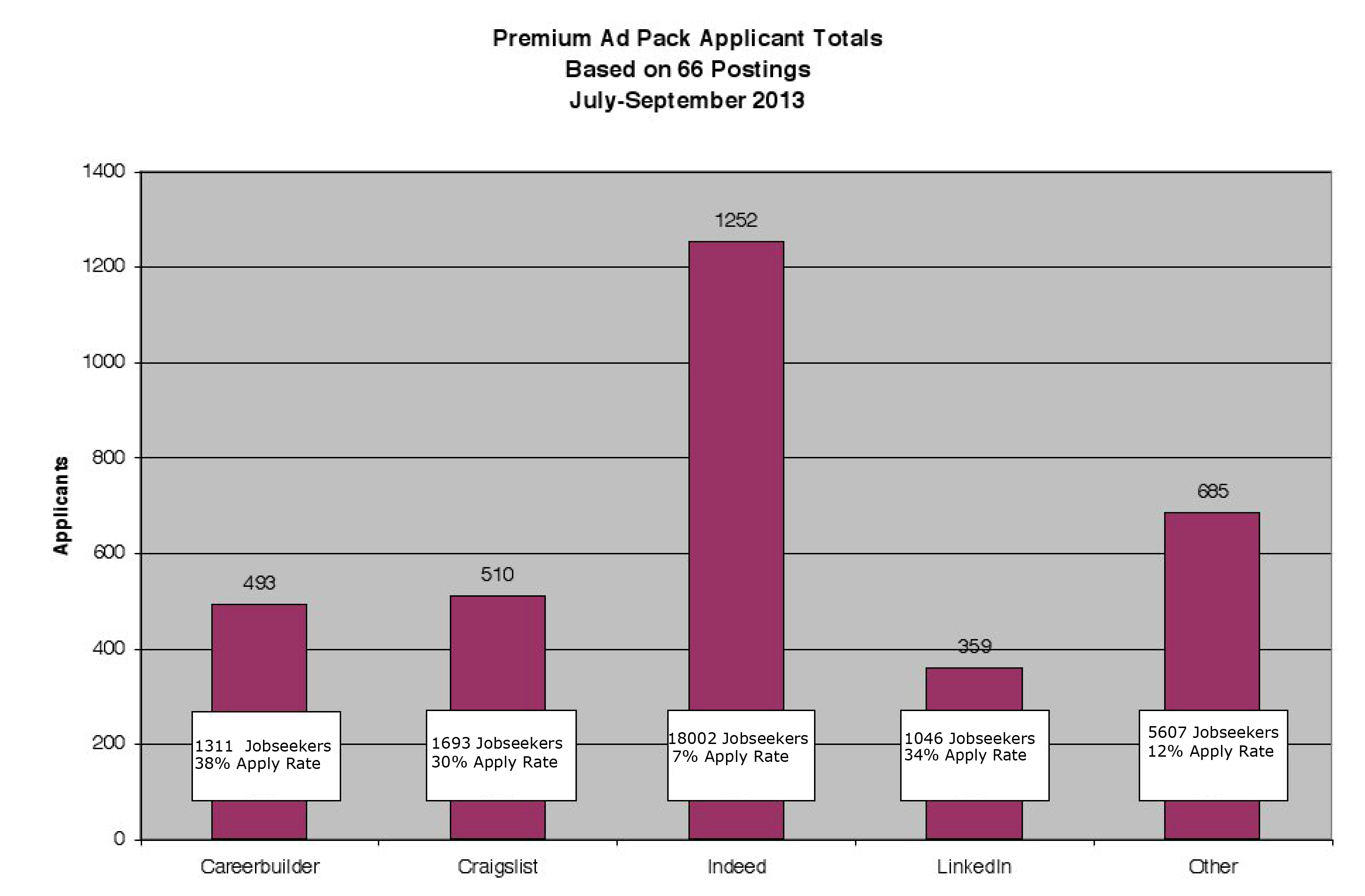
Indeed is the current juggernaut in the online recruitment advertising, delivering 38% of all applicants to a sampling of 66 open positions. This is more than any other single job board. The runner up, CareerBuilder, does not even come close. But that’s not the whole story because the combination of Careerbuilder, LinkedIn, Craigslist and all other boards delivered 62% of the total number of job applicants.

When sourcing candidates you can’t know in advance which source is going to provide the person you will hire. So our data shows that it is important to advertise your open position to as many jobseekers as possible.

In a previous blog, “Top Job Boards in 2013”, we explored which job boards delivered the most job-seekers. Our next step was to find out which of those job-seekers turn into applicants. What we found surprised us, and we think it might surprise you too.

The application rate — the conversion from job-seeker to applicant — from Indeed is far and away the lowest of any site surveyed. A strikingly high percentage of the job-seekers coming from CareerBuilder and LinkedIn are completing the applications.

Google Analytics Premium Ad Pack Applicant Totals Jul-Sept 2013 - small

Indeed accounts for almost 3 times the number of applicants than any other job board. We expected Indeed to be the leader because Indeed provides 10 times the number of job-seekers as the runner-up. But, the application rate from Indeed is the lowest of any site surveyed.

Here’s the first surprise: A high percentage of the job-seekers coming from CareerBuilder and LinkedIn are completing the applications. The application rate (conversion of job-seekers to candidates) is 38% for CareerBuilder, 34% for LinkedIn and 30% for Craigslist, while Indeed’s application rate is a lowly 7%.   

Here is what we think is happening. Applicants who use Indeed only see a small snippet of the ad. To see the entire ad, they have to click through and view NewHire’s application page, boosting Indeed’s job-seeker statistics. In comparison, applicants using CareerBuilder or LinkedIn can see the entire text of the ad and don’t need to click though. If they do click through, they are more likely to apply for the job.


The world of “other” job-boards continues to surprise.

The right bar in the graph labeled, “other,” is a combination of every other job site that referred job-seekers and applicants to NewHire. This group of “other” job sites sends us our second highest number of applicants and job-seekers. It’s crazy that the #2 performer is coming from sites that we don’t intentionally post to.

With thousands of smaller job-sites around the web continually picking up each other’s jobs, the Internet is working its interlinked magic to bring you more candidates.

So what does it all mean to you?

As job boards and aggregators feed into each other, the number of people who have access to your job ad increases. The job ads will even feed into sites that you never expected, driving more traffic. Continue posting job ads on a wide range of websites to maximize your exposure and build your pool of candidates!

How did we get all this data?

This graph shows the total number of applicants who applied to NewHire jobs between July and September 2013. Each of the 66 jobs shown here were advertised on the job boards shown, during concurrent time periods. All job-seeker and applicant data is gathered from Google analytics. A job-seeker viewed the NewHire application page while an applicant submitted the NewHire application with the minimum required fields.

 business question


Every one who has placed an online recruitment ad knows that it isn’t as easy as it seems. It isn’t easy to figure out which job boards to use. It takes time to actually get the ad posted on each job board, especially if you don’t do it very often.

On the other hand, it IS easy to be filled with doubt, leaving you wondering if the money and time you’ve spent will yield the desired result – a qualified candidate to hire.

Here are a few secrets to recruitment advertising success!

1. Use a common and familiar job title.

The job title is like a blog or newspaper article headline – it’s your best shot at getting candidates to read the rest of your ad. The job title is also the most important way to help the right candidates find your ad when they search. Use a common job title that other companies are using for jobs with similar duties and a similar salary range as the one you are recruiting for.

2. The ad copy matters.

The information you provide and the way you present that information has a big impact on the success of the ad. Think about the ideal candidate and make the ad attractive to them.

Recruitment advertising is a marketing and sales piece, not a screening tool. Does your ad say “Don’t apply unless…” If so, get out your favorite red pen and ask your self “what would my high school English teacher do to improve this ad?” Here are a few hints:

  • Does the ad sell the job and the company?
  • Do you list some cool, interesting or surprising things about the opportunity?
  • What’s great about the opportunity? Is it in the ad?
  • Do you say what’s in it for the candidate? Money? Perks? Vacation? Benefits? Work from home options?

3. Keep it short and easy to read.

People don’t read every word they see. How could they…there are so many words from so many sources. Candidates have many ads competing for their attention. You’ll be lucky if candidates scan the first paragraph to see if it’s worth further time investment. Combat this problem by:

  • Highlighting the most important information at the top
  • Using bolding, bullets, and short paragraphs to grab attention
  • Using active and engaging language
  • Include only 5 of the most important duties or requirements. (I wouldn’t read a list that is 25 items long, would you?)

4. Don’t be cheap.

Free is nice, but you get what you pay for. Brand name job boards and niche job boards are worth the money. At NewHire we track advertising ROI – so if you want to know where to get the most for your money – read these blogs.

If you know that the open position is going to be a challenge to recruit for, (because it is a high skill, high education, or high demand opportunity) be prepared to advertise widely, and spend a bit more money.

5. Use your network.

Social media is an important way to network, so post the job opening on LinkedIn, Facebook, and your company website. But don’t neglect word-of-mouth, your alumni association, other employees, or your mother-in-law – let people in your network know that you’re hiring.

6. I know – I said 5 secrets—but here’s the last one – I promise.

The real secret is that you can’t do just one of these things – you need to do them all, and do them well, to hire successfully. If you feel like you need a little help with your recruitment advertising – don’t worry you’re not alone.


Need help? Just ask.

resumesIt’s kind of amazing the amount of flak that job boards like Craigslist and CareerBuilder are getting from hiring managers.  It seems that there’s a growing consensus that job boards are ineffective tools for sourcing candidates.  Call me a detractor, but there’s nothing wrong with job boards.  It’s the lack of a process for utilizing them that’s the real problem.  Simply put, if you’re not using an applicant tracking system in tandem with a job board, you might as well throw your stack of resumes in the air and hope the right one lands in your lap.

Take a look at your sink. Imagine that instead of that nifty faucet with its spout funneling the water into your cup and its nozzles controlling the flow and temperature, there was just a hole at the top.  Without the faucet, you have no control over how much water you’re getting, where it’s going, or even how hot you want it.  The only way that your sink serves as a useful tool in your kitchen is if it’s paired with a faucet.  Otherwise all you have is a really effective way to soak your kitchen and/or possibly drown.

So therein lies the problem with job boards.  It’s not that they don’t deliver; it’s that they deliver too much – like a sink with no faucet.  Hiring managers are losing faith in job boards because they are getting overwhelmed by dozens, sometimes hundreds, of applications.  The problem with getting that many applications is that it’s simply too many to manually sort through.  There are undoubtedly qualified candidates in that pool, but finding them is like finding that needle in a haystack.

You’re not a robot and you don’t have an infinite amount of time, so at best, reviewing every application for the right mix of skills and experience is going to be a massive, time-consuming effort.  But dumping that entire pool of applicants into the trash bin isn’t a smart move because there are qualified candidates who match up well with the job.  You need a solution that that combines the speed and accuracy of a robot with the skills of a hiring manager.  You need a solution that efficiently sorts through the applicant pool so that you can find those qualified candidates.

NewHire is an applicant tracking system that hundreds of companies have used to hire thousands of employees, with the vast majority of those hires coming from the biggest job boards.  This isn’t so much a pitch for NewHire as it is a testament that job boards are not the useless avenue of recruiting that some hiring managers would have you believe.  For your money, there is no better way to reach as large an audience or to get as deep an applicant pool as through a job board.  However, if you want to maximize the benefit you get from using a job boards, you need a system in place that cuts through the unqualified applicants and just delivers the candidates you want to see.

6http://www.flickr.com/photos/76029035@N02/

The first step in an effective recruiting process is to clearly define who you need to hire. The easiest way to achieve this is to create a job description for the open position. Simple enough, right? What you may not know is that many job descriptions leave out key information which could save money, time, and resources during the recruiting process.

Remember that a job description is an internal document to guide you throughout the recruiting and hiring process. It need not follow our guidelines word for word, nor should it be used as a classified ad.

Drawing on over 20 years of recruiting experience, we offer the following guidelines to ensure that you’re taking the proper first step in creating a complete job description:

    1. Job Title – Make the title clear and reflective of job duties. Be sure to use a accepted title for this type of position. That way, people outside of your organization who may not be familiar with your corporate language will still understand the person’s role.
    2. Basic Functions – Write two sentences describing why the job exists. If you cannot completely express the key functions of the position in only two sentences, you may have more than one position to fill. On the flip side, if you cannot create two sentences about the key functions of a position, you may not have enough duties that require a position to be filled.
    3. Reporting Relationships – Explicitly state with whom this person will be working and to whom this person will be reporting.
    4. Authority – Provide examples of decisions which the person in this position can make without any outside authorization (for example, hiring, firing, pricing, check signing, etc.)
    5. Responsibility & Principal Duties – Draft these in the form of a charge: “The (Job Title) is responsible for…” Be sure to also include a detailed list of specific primary and secondary duties.
  1. Job Requirements, Past Work History, Education and Software Competencies – Indicate the requisite level of education, any required experience and any necessary software knowledge.
  2. Criteria for Measuring On-the-Job Success – This is possibly the most important part of the job description. Define the specific goals or targets which will define success by using the SMART method:
    Specific
    Measurable
    Actionable
    Reasonable
    Time-bound (deadlines)
  3. Physical activities and requirements of this position – if applicable.
  4. What makes this an attractive job opportunity? – Describe why this is a great job. Write a few sentences highlighting the most alluring aspects of the position, including location, office environment, benefits, pay range, exciting responsibilities, or even perks like a cell phone or company car.
  5. Compensation range – Include hourly wage or salary information, as well as information about employee benefits.

Many of these aspects will also be featured in the job advertisement. However, it is important to remember that the job description is an internal document to guide you through the recruiting and hiring process. It should NOT be used verbatim as a classified ad. When you write the job advertisement, you need to sell the company and the job to job seekers.

Is it worth the money to sponsor jobs on Indeed (pay-per-click advertising), when there is a free (organic) option available? At NewHire we hear this question pretty frequently.

The short answer is “yes,” purchasing sponsored (pay-per-click) advertising on Indeed is worth the investment. But I don’t expect you to take me at my word; instead, I’d like to show you the evidence that it’s worth to sponsor jobs on Indeed.

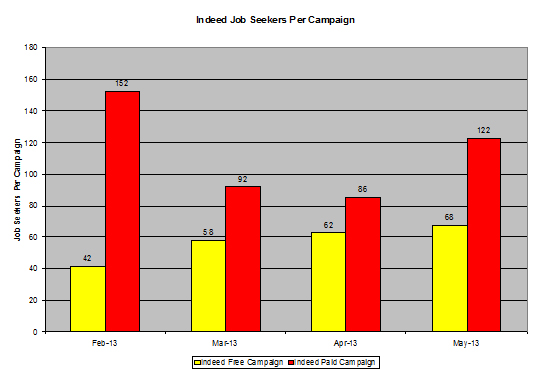
Indeed sponsored ads campaigns attract an average of 113 job seeker views per campaign while organic (free) campaigns attract 57 job seeker views per campaign. This means that a sponsored campaign on Indeed attracts almost twice as many job seekers as organic campaigns.  Here is a graph showing the information for 4 recent months.

Indeed jobs chart

How did we get this information?

(As a recovering nerd I just can’t help but provide the details.)

We track recruitment advertising Return-On-Investment (ROI), so that we can provide our customers with information about how best to spend precious advertising dollars to build a candidate pool. We use Google Analytics, Server logs, and applicant data in NewHire to collect and compile the information we provide.

Here’s the data averaged for February, March, April and May 2013:

Total Active Campaigns

Average

Active Jobs

407

Total Job Seeker Views (traffic)

28454

Total Applicants (all sources)

5563


Indeed Campaigns

Free Campaign Average Paid CampaignAverage
Number of Campaigns

158

45

Total Job Seekers Views (traffic)

9157

4773

Job Seekers per Campaign

57

113


Averages shown are for managed campaigns Feb, March, April and May 2013. Only job seekers from Indeed were considered for this table.

Looking at the Job Seeker traffic, you’ll notice that all the job seekers coming from Indeed only represent a small fraction of our total Job Seeker traffic.

Where does that other candidate traffic come from? For the active jobs discussed here, Indeed is just ONE of many advertising outlets being used to promote each job. Candidates are coming from CareerBuilder, Craigslist, LinkedIn, and the NewHire job board, (and these are just primary sources). For information comparing various job boards’ ROI, visit our previous blog “Top Job Boards of 2013. (/blog/top-job-boards-2013-job-sites-post-job-ad/)

Remember that Job Seeker traffic is also coming from emails and from a myriad of other partner job boards that are re-posting ads. Stay tuned for more updates — over the coming months we’ll continue to explore candidate traffic sources!

abstract-13640_640 referrals

It’s no secret that employee referrals are the gold standard in recruiting.  Studies, testimonials, and hiring trends all confirm the same thing: referrals are more productive, more engaged, and more committed than employees referred through a job board.  Yet for all the praise that hiring managers heap on referral programs, not every position can be filled by someone that knows someone.  Sometimes you’ll need to tap into a larger applicant pool than your employees can supply.  Below are the keys to replicating the success of employee referrals, even when your applicant pool is made up of strangers from a job board

Qualified Applicants

Employees that participate in your company’s referral program don’t just message all their contacts: “My company is hiring.  It pays money.  Who wants it?”  Their referral is a reflection on them, so they’re more likely to recommend someone they feel is a great fit for the position.  In order to do that, they need to consider the job, what its requirements are, and what skills are necessary to be successful.  Then they need to examine their circle of contacts to find the best fit.

That’s the same process you need to follow — examine an opening to uncover the skills and traits needed to be successful, then create a job posting that sets your company up to identify those qualities in your applicants.  If done correctly, you’ll be able to make the same informed decision about the people in your applicant pool as your employee is able to make about her friends.

Productive and Engaged Employees

There isn’t anything inherently magical about referral hires that make them more productive and engaged than employees you find through job boards.  In truth, the reason productivity and engagement are higher among employee referrals is because your employees screen their contacts for the ones that are the right fit for the position AND the company.  Even though it’s an informal process, those employees use their personal history with their contacts to find the one whose personality fits in the best with how your company operates.  If there’s a “round hole” position available, then the contacts they refer are the round pegs, not the square ones.

There are resources available that allow you to effectively identify the round pegs, square pegs, hexagonal pegs, etc.  If you invest in personality assessment like DISC, PIAV, or MBTI profiling, you have an opportunity to find the applicants whose personality aligns with the job and the company.   In aligning workplace personalities with your company’s style, you create something valuable for your employees.  Their job becomes more than just an appointment in their schedule; it becomes something they look forward to doing and doing well.  It’s that value that motivates employees to be more productive and engaged at work.

job gauntlet

The best performing job ads sell both the company and the open position to potential candidates, attracting a strong response and a solid pool of qualified candidates. Our experience and data consistently show that the best performing job postings – those which provide the greatest number of qualified candidates – have a clear value proposition for applicants. The employment value proposition is a statement that answers these two questions:

  • Why is this company a good place to work?
  • What are the interesting and attractive duties and responsibilities of the open position?

When you include this kind of information about the open position and company, your ad will stand out to job seekers. But one look at the majority of ads on any of the major job boards tells a different story.

Here are two examples of poor advertising strategies that are running on major job boards at this time:

  • In one ad, the company description consists solely of “a fast-growing, dynamic company seeks a…” and then lists all required qualifications. If all a candidate knows about a company is that it’s fast-growing and dynamic, then they become meaningless adjectives and it can be a turn-off to people looking for a rewarding position at a good company.
  • Another ad listed 17 “must-have” qualifications immediately followed by this phrase: “A criminal background check (both state and federal) WILL BE PERFORMED before a hiring decision is made!” Emphasis on that many qualifications immediately followed by the threat of a background check conveys distrust in employees and a hostile office environment.

These types of ads conjure images of employers scrambling to develop foolproof gauntlets of “musts and must nots” to deter people from applying. While this may sound familiar, it’s not a best practice for attracting top talent.

If you’re currently using the gauntlet method to prevent unqualified applicants from applying to your job, stop! When you screen and identify qualified candidates using application questions, there is no need to use the classified ad to deter people from applying. In fact, the opposite applies. Use the classified ad as a sales and marketing tool and feature the best aspects of open position. In short, sell your company and your job.

If you’re writing the ad yourself and you’re unsure of where to start, we’ll make it easy for you. We have designed this fill-in-the-blank Job Ad Mad Libs® as a guide to the elements which help set your recruitment advertisements apart from those that use the gauntlet method.

6829409437_8a655ddabe_z


In the age of online-based recruiting, there are many ways candidates get an impression of your company — on your website, on job boards, and on employer-review websites. Candidates can find out a lot about what your company is like before even stepping into your place of business.

Not everything online about your company will be coming from you. In fact there are several sites online that encourage current and former employees to rate your company and write about their experiences. Similar to Yelp (where people post and rate their shopping and dining experiences) sites like Glassdoor have corporation pages that encourage the same review style from your employees and then display your rating next to all your job postings.

If your reviews are all 5 stars, that can be wonderful publicity for your job postings. In fact, Indeed has a Best Places to Work page with the top rated companies and links to their currently open jobs. On the downside, a negative review can give your company a bad image and make your job postings less desirable to candidates. In this situation you can do a few things to address this bad posting.

1. Write a response

Most sites let employers chime in for their point of view, and this is a highly effective way in order to combat the negative review—as long as it is handled in a open and professional manner. A defensive response may actually do more harm.

2. Flag the review

If there is particularly egregious language in a review you can use the flag feature in order to have the hosting site review and remove the comment. Using this for censoring comments is ill-advised. First, sites will review the comment and if they do not find a problem it will not be removed. Second, abuse of this feature can get your company banned or prohibited from commenting or participating.

3. Get more reviews

Reach out to former employees that you know have had a good experience working for you and ask them to write a review that encompasses how they feel about the company. However, it’s important not to dictate what they should write or to make employees write it as part of their job description.

Having a bad review can hurt your company image and affect your job postings. However, if they are addressed in a professional effective manner you can minimize the affect they’ll have on your recruiting.


Have you ever had negative statements directed at your company online? What did you do?