The coming year will be a challenging year for finding the talent you need to grow your business. This is not a prediction. It is the current reality and it is not likely to change in the next 12 months. Employers have had it easy for a few years now, taking advantage of large pools of candidates and little wage growth. New realities require new strategies and tactics. They require smart hiring solutions. Want to know how to be prepared?
Here are four trends and hiring solutions that will help you hire better in 2015.
1. More jobs available
Look at the most recent chart from the Bureau of Labor Statistics. You don’t have to be a math whiz to see the upward trend in available jobs:

Small and mid-sized businesses looking to hire staff face nearly double the competition. Just this week, three candidates (two for a client and one for us) canceled their interviews the morning of, saying that they had taken full-time jobs.
In order to get the talent you need, your recruiting is going to have to be both slower and faster.
By slower I mean: you must plan further in advance, start recruiting well before you need a person to start, and expect the process to take longer than before. By faster I mean: you must review candidates more quickly, move through the interview process with dispatch, and make offers without dilly-dallying. Expect candidates to negotiate for more money, benefits, and flexibility.
2. Increased willingness of your employees to change jobs
For most industries and most geographies, business has been steadily improving since 2012. Employers and employees have taken some time to modify their bunker mentality, but the change has come. Your employees are looking for opportunities to “learn more, earn more and do more.” If they don’t get those opportunities from you, they’ll get them from another employer.
At a minimum, you must complete employee reviews. Think about whom you must retain, who you’d prefer to keep, and who you’re okay with letting go. Spend your time with employees in that order.
If you’re thinking about strategies or tactics to keep employees happy, make sure that what you do aligns with what they want. Knowing your employees’ natural motivations allows you to create rewards customized to their wants. For instance, creating a bonus plan for a person who would prefer to take an enrichment course may be ineffective.
3. Perceived and real skills gaps
My favorite Rolling Stones song says it best: “You can’t always get what you want, but if you try, sometimes you get what you need.”
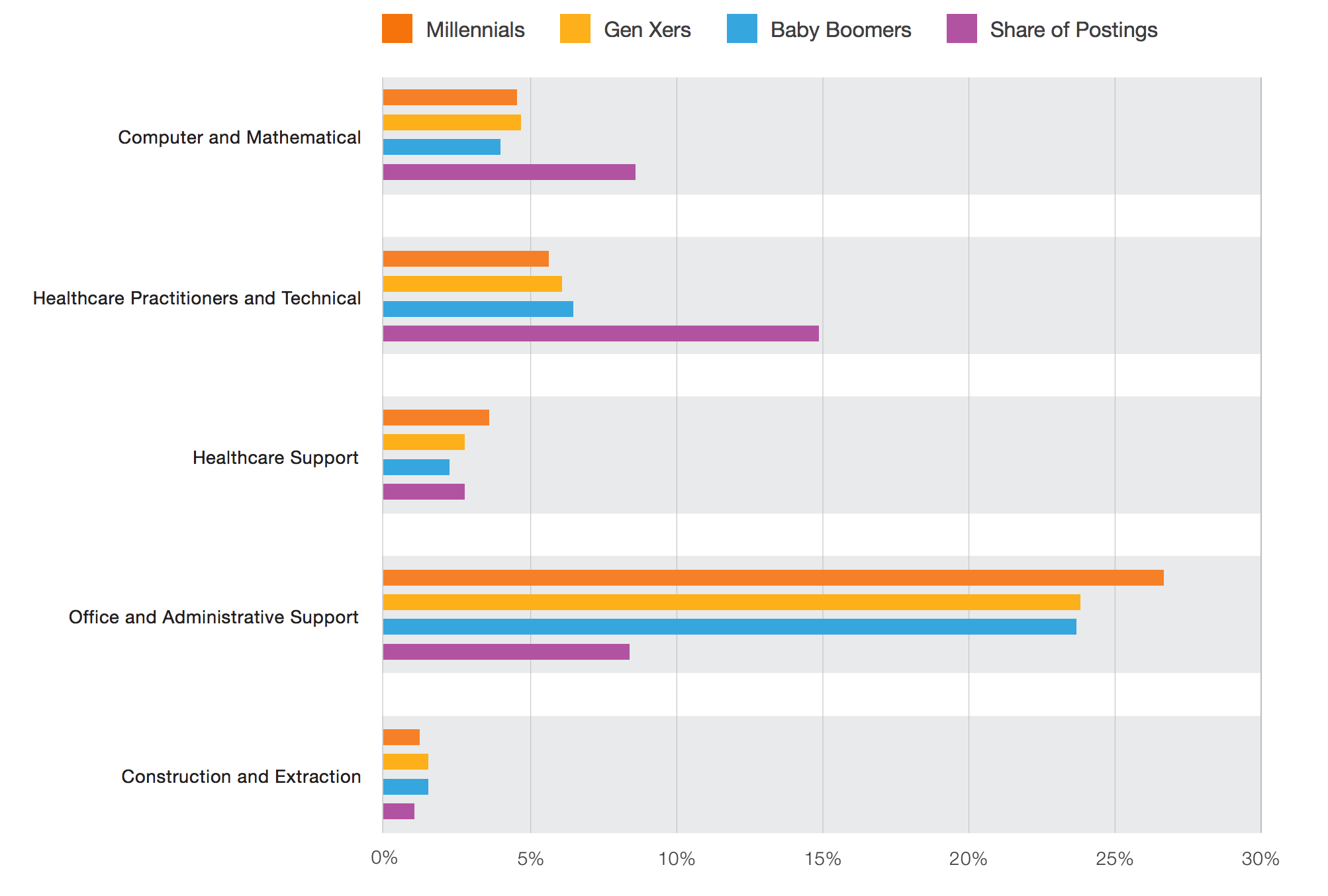
Manufacturing operations, IT support, software development, Healthcare practitioners and technicians, and almost all kinds of sales representatives… these employment categories have many more openings than they have qualified candidates. Just because you NEED to hire these people doesn’t mean that you can. The chart below compiled by Indeed.com shows the number of available jobs in purple and the potential applicants by generation. Note the gap in technical and healthcare and the over-abundance of administrative candidates.
Bidding wars are breaking out for the talented and experienced. Signing bonuses are common in IT. SMBs can’t compete on compensation with larger companies. What can your business do to combat this problem?
Make peace with the idea that you will be hiring more junior people and training them. Some will stay and some will move on, but it will work out if you’ve built the idea into a long range plan. Your advantage will be a larger pool of talented candidates who have aptitude and desire without experience. You’ll be able to afford to invest in them.
4. Accelerating Boomer retirements
The retiring Baby Boomer is exacerbating the skill gap trend. According to FiveThiryEight.com’s Ben Casselman, “In 2003, 82 percent of boomers were part of the labor force; a decade later, that number has declined to 66 percent, and it will only continue to fall.” This trend has many far-reaching consequences that we don’t have the space or time to address here.
However, when it comes to employment issues, here’s one important fact: Skilled Baby Boomers will take an immense body of knowledge with them into retirement. Employers must actively facilitate the knowledge transfer from Boomers to GenXer’s and Millenials.
A large number of our clients are facing the need to replace retiring Boomers. Make sure you allocate enough time to identify, hire and train new people. Wait too long and you may face critical failures in your operation.
The War for Talent is back in full force. What are your predictions for hiring trends for 2015? What hiring solutions will you employ to win the battle?