Archives For Leora Baumgarten

A recent business blog from the Huffington Post suggested that 2014 is the year of workplace reinvention. The blog explored the benefits of Results-Only Work Environment and Self-Managed organizations.

These ideas seem great. But I’m not wholly convinced. I’d love to feel secure that everything at our company was running smoothly without ever asking for a project update or report. It would be even better if I knew that my employees held each other accountable for excellence and on-time delivery etc. I would love it if they could do their jobs any time any where, in a way that wouldn’t cause me endless worry.

Is it possible? What can I do, as an owner and entrepreneur, to help my staff achieve a workplace re-invention that works for them, for me and for the profitability of the company in 2014?

I try to hire people who are naturally rewarded by the tasks of the job. I try to foster team work. I try to answer most questions with a question. I try to provide enough information about our strategic goals that we can all paddle in the same direction — all year long. But it’s hard. My tendency is to tell people what to do and how to do it — because after all – I’m the boss.

The funny thing is that when I started answering questions with questions – better solutions and better work was produced. Projects seem to go better, faster, and have a positive outcome when I get out of the way. I’ve been rewarded for taking the risk.   Is that surprising?

I’m committing to continue to shift my leadership and management strategies to a results oriented environment, even though sometimes, and for some jobs, time and location are important too.

In September we made the decision that it was time to hire for NewHire. Since we provide companies all over the US with the candidates, tools and coaching to help hire better, you might think that our internal recruiting is boiler plate. But from my perspective as an owner, hiring has complex emotional, strategic, and tactical implications.

Here are some of the things that I was thinking about.

My Excitement list:

  • Cool, business is strong, we’re growing and we need additional capacity.
  • We’ve meet key strategic goals!
  • It will be fun and interesting to add someone new to our team.

My Fear and Worry List

  • Which job title should we hire for?
  • What if we mess this up? That could be an expensive burden!
  • Who is doing the work?
  • How much is it going to cost?
  • When’s the right time to start recruiting
  • When’s the right time to for a new person to start?

You might notice that my Worry list is twice as long as my Excitement list.

For several years we’ve been committed to a strategy of promoting proven talent and hiring entry level candidates. We typically hire for an administrative role, looking for recent college grads who demonstrate personal motivation, a willingness to learn, work hard, and have some past work history. Since we are in a “people business” I care that their job had lots of opportunity to interface with a variety of people. Sometimes past recruiting experience is important, but not this time around. This is the strategy that guides me.

What about the tactics? Perhaps I’m lucky. I admit. We have a step-by-step recruiting process (including tools) ready to go. I also have a solid idea of the advertising cost. All I have to do is assign the project and sound that starting gun.

Because I have a hiring strategy and tactics, in place I was able to get started with our recruiting even though some worries remained.

What keeps you awake at night when you are getting ready to hire?

 business question


Every one who has placed an online recruitment ad knows that it isn’t as easy as it seems. It isn’t easy to figure out which job boards to use. It takes time to actually get the ad posted on each job board, especially if you don’t do it very often.

On the other hand, it IS easy to be filled with doubt, leaving you wondering if the money and time you’ve spent will yield the desired result – a qualified candidate to hire.

Here are a few secrets to recruitment advertising success!

1. Use a common and familiar job title.

The job title is like a blog or newspaper article headline – it’s your best shot at getting candidates to read the rest of your ad. The job title is also the most important way to help the right candidates find your ad when they search. Use a common job title that other companies are using for jobs with similar duties and a similar salary range as the one you are recruiting for.

2. The ad copy matters.

The information you provide and the way you present that information has a big impact on the success of the ad. Think about the ideal candidate and make the ad attractive to them.

Recruitment advertising is a marketing and sales piece, not a screening tool. Does your ad say “Don’t apply unless…” If so, get out your favorite red pen and ask your self “what would my high school English teacher do to improve this ad?” Here are a few hints:

  • Does the ad sell the job and the company?
  • Do you list some cool, interesting or surprising things about the opportunity?
  • What’s great about the opportunity? Is it in the ad?
  • Do you say what’s in it for the candidate? Money? Perks? Vacation? Benefits? Work from home options?

3. Keep it short and easy to read.

People don’t read every word they see. How could they…there are so many words from so many sources. Candidates have many ads competing for their attention. You’ll be lucky if candidates scan the first paragraph to see if it’s worth further time investment. Combat this problem by:

  • Highlighting the most important information at the top
  • Using bolding, bullets, and short paragraphs to grab attention
  • Using active and engaging language
  • Include only 5 of the most important duties or requirements. (I wouldn’t read a list that is 25 items long, would you?)

4. Don’t be cheap.

Free is nice, but you get what you pay for. Brand name job boards and niche job boards are worth the money. At NewHire we track advertising ROI – so if you want to know where to get the most for your money – read these blogs.

If you know that the open position is going to be a challenge to recruit for, (because it is a high skill, high education, or high demand opportunity) be prepared to advertise widely, and spend a bit more money.

5. Use your network.

Social media is an important way to network, so post the job opening on LinkedIn, Facebook, and your company website. But don’t neglect word-of-mouth, your alumni association, other employees, or your mother-in-law – let people in your network know that you’re hiring.

6. I know – I said 5 secrets—but here’s the last one – I promise.

The real secret is that you can’t do just one of these things – you need to do them all, and do them well, to hire successfully. If you feel like you need a little help with your recruitment advertising – don’t worry you’re not alone.


Need help? Just ask.

6http://www.flickr.com/photos/76029035@N02/

The first step in an effective recruiting process is to clearly define who you need to hire. The easiest way to achieve this is to create a job description for the open position. Simple enough, right? What you may not know is that many job descriptions leave out key information which could save money, time, and resources during the recruiting process.

Remember that a job description is an internal document to guide you throughout the recruiting and hiring process. It need not follow our guidelines word for word, nor should it be used as a classified ad.

Drawing on over 20 years of recruiting experience, we offer the following guidelines to ensure that you’re taking the proper first step in creating a complete job description:

    1. Job Title – Make the title clear and reflective of job duties. Be sure to use a accepted title for this type of position. That way, people outside of your organization who may not be familiar with your corporate language will still understand the person’s role.
    2. Basic Functions – Write two sentences describing why the job exists. If you cannot completely express the key functions of the position in only two sentences, you may have more than one position to fill. On the flip side, if you cannot create two sentences about the key functions of a position, you may not have enough duties that require a position to be filled.
    3. Reporting Relationships – Explicitly state with whom this person will be working and to whom this person will be reporting.
    4. Authority – Provide examples of decisions which the person in this position can make without any outside authorization (for example, hiring, firing, pricing, check signing, etc.)
    5. Responsibility & Principal Duties – Draft these in the form of a charge: “The (Job Title) is responsible for…” Be sure to also include a detailed list of specific primary and secondary duties.
  1. Job Requirements, Past Work History, Education and Software Competencies – Indicate the requisite level of education, any required experience and any necessary software knowledge.
  2. Criteria for Measuring On-the-Job Success – This is possibly the most important part of the job description. Define the specific goals or targets which will define success by using the SMART method:
    Specific
    Measurable
    Actionable
    Reasonable
    Time-bound (deadlines)
  3. Physical activities and requirements of this position – if applicable.
  4. What makes this an attractive job opportunity? – Describe why this is a great job. Write a few sentences highlighting the most alluring aspects of the position, including location, office environment, benefits, pay range, exciting responsibilities, or even perks like a cell phone or company car.
  5. Compensation range – Include hourly wage or salary information, as well as information about employee benefits.

Many of these aspects will also be featured in the job advertisement. However, it is important to remember that the job description is an internal document to guide you through the recruiting and hiring process. It should NOT be used verbatim as a classified ad. When you write the job advertisement, you need to sell the company and the job to job seekers.

Is it worth the money to sponsor jobs on Indeed (pay-per-click advertising), when there is a free (organic) option available? At NewHire we hear this question pretty frequently.

The short answer is “yes,” purchasing sponsored (pay-per-click) advertising on Indeed is worth the investment. But I don’t expect you to take me at my word; instead, I’d like to show you the evidence that it’s worth to sponsor jobs on Indeed.

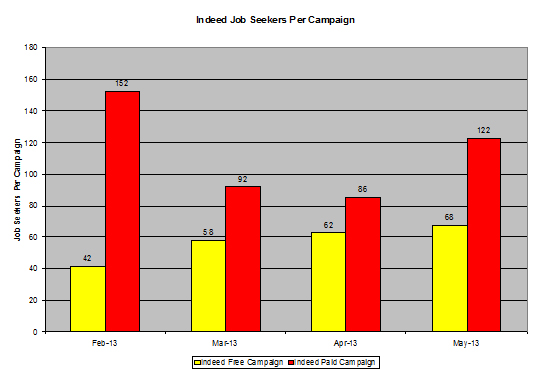
Indeed sponsored ads campaigns attract an average of 113 job seeker views per campaign while organic (free) campaigns attract 57 job seeker views per campaign. This means that a sponsored campaign on Indeed attracts almost twice as many job seekers as organic campaigns.  Here is a graph showing the information for 4 recent months.

Indeed jobs chart

How did we get this information?

(As a recovering nerd I just can’t help but provide the details.)

We track recruitment advertising Return-On-Investment (ROI), so that we can provide our customers with information about how best to spend precious advertising dollars to build a candidate pool. We use Google Analytics, Server logs, and applicant data in NewHire to collect and compile the information we provide.

Here’s the data averaged for February, March, April and May 2013:

Total Active Campaigns

Average

Active Jobs

407

Total Job Seeker Views (traffic)

28454

Total Applicants (all sources)

5563


Indeed Campaigns

Free Campaign Average Paid CampaignAverage
Number of Campaigns

158

45

Total Job Seekers Views (traffic)

9157

4773

Job Seekers per Campaign

57

113


Averages shown are for managed campaigns Feb, March, April and May 2013. Only job seekers from Indeed were considered for this table.

Looking at the Job Seeker traffic, you’ll notice that all the job seekers coming from Indeed only represent a small fraction of our total Job Seeker traffic.

Where does that other candidate traffic come from? For the active jobs discussed here, Indeed is just ONE of many advertising outlets being used to promote each job. Candidates are coming from CareerBuilder, Craigslist, LinkedIn, and the NewHire job board, (and these are just primary sources). For information comparing various job boards’ ROI, visit our previous blog “Top Job Boards of 2013. (/blog/top-job-boards-2013-job-sites-post-job-ad/)

Remember that Job Seeker traffic is also coming from emails and from a myriad of other partner job boards that are re-posting ads. Stay tuned for more updates — over the coming months we’ll continue to explore candidate traffic sources!

http://www.flickr.com/photos/76029035@N02/

Strong interviewing skills can mean the difference between finding your next star employee and making a bad hire. The pressure is on and the interviewer can be as nervous as the interviewee! The interview is your best opportunity to find out if a candidate who looks good through the initial screening process, will be a positive addition to the team. Here is the wisdom gained from more than 20 years of experience interviewing candidates. We learned it the hard way, so you don’t have to.

Before the Interview – Prepare

When the interviewer looks good during the interview the company looks good too, so prepare for the interview and put your best foot forward! Make an interview game plan, and coordinate with everyone who will be interviewing the candidate.

Start by reviewing all available information, including: the candidate’s application, resume, notes from the phone interview and assessment results. Review the job description, too. Next, prepare questions relating to experience, work behaviors, future goals and key accountabilities. Don’t forget to ask questions about significant items like accomplishments, gaps in employment, special skills, leadership activities and hobbies. And remember — some questions are ILLEGAL to ask. Click here for a list of topics that could get you into hot water. Make some notes to use during the interview, especially if you don’t interview very often.

During the Interview — Ask then Listen

Begin with an introduction and a handshake. This sounds obvious, but a warm greeting can go a long way to ratcheting down everyone’s nerves, which will result in more candid responses from the interviewee. Don’t forget to make small talk, ask about the drive to the interview, last night’s unbelievable hail storm, the ball game, or the American Idol competition.

Start the interview using the resume and your notes as a reference. Some interviewers like to ask about every position on the resume. Try it and see what you learn. You might ask the candidate to relate what their supervisor would report as their strengths and weaknesses. This will give you the chance to assess the candidate’s self-awareness, as well as their strengths.

Ask open-ended questions; avoid those that can be answered with a Yes or No. Situational and scenario-based questions are a great tool. Ask questions that begin, “Tell me about a time…” Wait for an answer. Don’t be afraid of silence!

When it’s time to end the interview, ask if the candidate has any additional questions. Be honest and forthcoming about the company and the position as you answer. Surprises can hurt both you and the candidate in the long run. Thank the candidate for their interest and for taking the time to come in for an interview.

Final Thoughts

The goal of an interview is to get an in-depth knowledge about this person’s background and work history, but you are also trying to get a feel for this person’s character, work behaviors and attitudes. Here are some cues and clues to watch for. Does your interviewee:

  • Maintain eye contact and show enthusiasm?
  • Have good communication skills answering questions clearly?
  • Avoid tough questions by changing the subject?
  • Demonstrate respect and friendliness?
  • Pay attention to what you are saying?
  • Use negative language when talking about past employers?
  • Show engagement and interest in the position and the company by asking unscripted questions about what you have said?

Additional resources:
1. An Interviewing Guide: What You Can and Cannot Ask
2. Interview Tips

http://www.flickr.com/photos/76029035@N02/

Building a solid candidate pool for an open position can be a challenge. Employers need to be aware that they could be their own worst enemy. Employers can create a negative impression when candidates have a poor or unpleasant experience applying for the position. However, when employers consider the candidate perspective it is easy to find a few ways to improve the process. These six actions will improve the candidate experience and also improve and build your candidate pool.

1. No Broken Links

Make sure the “apply” link from the job board to your application is working. Nothing is more frustrating for a candidate than finding a job listing for the perfect job and not being able to apply because the “apply” link is broken.

2. An Easy to Use Application

In recent data released by CareerBuilder, 52% of candidate’s don’t apply because of some issue with the technology of the application! Wow. Don’t lose half your candidate pool because of technical issues.

3. Your Employment Brand Matters

Provide clear information about the job and the company. 87% of candidates applied for jobs where they reported the posting was very effective. However, if they felt that there wasn’t enough information about the job or the company they were much less likely to apply.  According to US News, “…employers should provide a clear and honest description of the role.”

4. Improve Candidate Confidence

Candidates are savvy and smart. If your company is not a well known brand, it’s important to include additional information that builds confidence in the job and the company. Include your web address, the salary range you’re offering, and information about key products, industries or customers.

5. Candidates Hate Being in a Black Hole

If you’ve spoken to a candidate on the phone or in a face-to-face interview, let them know what’s going on.

6. Respect Your Candidates’ Time

If you are using screening questions, ask questions that are related to the job. If the job the candidate is interviewing for has changed a lot from what was advertised, let candidates know. Don’t let the final stages of the process drag on into a seemingly unending set of interviews and assessments.


http://www.flickr.com/photos/76029035@N02/

The City of Chicago recently emailed me a Business Newsletter. Hidden among the articles announcing a chamber of commerce survey, community based business expos, and construction on a heavily used bridge in downtown Chicago, there was an article about hiring policies that caught my eye. The big red headline shouted: “Make Sure Policies Apply Equally to Applicants, Employees.”

Since applicants and employees are not the same, how can policies be applied equally to those two groups?

The Chicago Human Rights Ordinance prohibits discrimination against employees and job applicants based on their type of family membership. Do you know if your municipally has a similar ordinance?

Here are a few examples of discriminatory conduct that were provided:

  • A policy or practice which limits job opportunity because of pregnancy, childbirth, or related conditions
  • Refusing to hire because the applicant lives with dependent minor or disabled children.
  • Giving preference to married candidates for  jobs or promotions over those who are unmarried.

Regarding the pre-employment process (recruiting), “A prospective employer may not ask a job candidate for information which directly or indirectly expresses intent to discriminate based on pregnancy, parental status, or marital status.”

Be on the safe side and avoid all questions about a candidate’s current family status or future plans! Don’t ask about the health or babysitting arrangements for dependent children, especially during a job interview.

The law requires equal treatment under similar circumstances, regardless of one’s pregnancy, parental status, or marital status.

Another way to protect yourself from violating these laws is to use a reproducible recruiting process. That means that you use the same steps and use objective hiring criteria for each job you hire for. Your recruiting process should include a job application that asks every single candidate to respond to the same set of questions. Additionally, when screening candidates, be sure that the hiring criteria is based on the key accountabilities of the position and not by a recruiter’s or hiring manager’s arbitrary decision making. Check out these documents for more interviewing tips:

Interviewing guidelines

Interviewing Tips

Do you have tips or guidelines on interviewing best practices that you’d like to share?

Tie short

The worst of the downturn is behind us and there are more and more open positions being advertised – one of them could even be at your company! When you are recruiting it’s important to project a great company image. Projecting a great company image helps attract the right candidates to apply for your job. Alas, smaller or owner-operated companies don’t always have a well known or recognized brand to fall back on. We can’t just rely on applicants knowing who we are; we have to work at projecting a great company image.

Here are 5 ways to project a great company image and build a stronger employment brand:

1) Make sure your website has a careers page that is up to date.

Make sure you are taking advantage of any free advertising you can get on your company web page. Your customers and vendors who visit the site are a great target for a future employee. Don’t alienate them. Be sure you’re not listing jobs that no longer exist, or are closed. Be specific, be accurate and be current.

2) Include an Employee Value Proposition in every recruitment ad.

What’s an employee value proposition? Simply put, it’s the information you give candidates that tells them why this is a great job at a great company that has great prospects. The employee value proposition also tells candidates, clearly and concisely, what is in it for them. Yes, compensation, benefits, perks, and even corporate culture help project a great company image. Be sure to mention casual Fridays, quarterly lunches paid for by the company, or that the radio is always on. Be sure to tell prospective employees about whatever it is that makes your company a good place to work.

3) Provide applicants with a clear and easy way to apply for the job.

In today’s world, asking people to fax a resume is kind of like telling them you’ll just be placing it in the “circular file”. Asking candidates to fill out a generic application form is a bit better, but it doesn’t do much for your company image. Instead, each position should be unique and offer a unique and easy to use online application.

4) Respond to candidates promptly.

At the minimum, let candidates know you received their application. If they are qualified and you want to speak to them, tell them. And don’t wait around. Your best candidates are probably someone else’s best candidates too. The sooner you respond, the more attractive and on-the-ball your company looks. Here’s the hard part: if you need to say “no” to a candidate who you interviewed, do it. Don’t leave good candidates hanging. Nothing projects a negative image like leading someone on, or never letting them know that they didn’t get the job.

5) Ask current employees to complete employer reviews on sites like Indeed and Glassdoor.

The power of social media can’t be underestimated in projecting a good company image. Ask current employees to review your company, so prospective applicants can learn about what it’s like to work at your company.


frustrated

There are some questions and concerns that we see repeatedly with our clients when it comes to hiring. We’re putting together a 5-part series to address the top reasons why small and mid-sized businesses have a hard time hiring. Up first – building candidate pools!

Question 1:

“We are having a hard time hiring for this position — hardly any candidates are applying! How do we do get more people to apply?”

You’ve been advertising the job and hardly anyone is applying. You’re probably right to be worried. There can be a few different reasons that no one is applying. Here are 4 possibilities:

1) The job title is unusual or uncommon.

In the world of internet job board advertising, candidates need to be able to find the job by searching on keywords. If the job title is unusual or doesn’t reflect the duties or salary being offered, appropriate candidates might not be finding the ad. Start by researching what the job titles other companies are using for similar positions. Use CareerBuilder or Indeed to search for similar jobs, then make the appropriate change to your job title.

2) The job isn’t competitive in the market place.

The salary, wages, or benefits offered aren’t competitive with those offered for comparable jobs. Candidates might not be interested if the job isn’t attractive. Make sure your salary and benefits are competitive.

3) Talent is scarce for the position.

If you’re looking to hire a highly-specialized engineer for your company based in Small Town, Wyoming, you may find that the available local talent pool is more limited than it might be in a major metropolitan area. If that’s the case, you might have to hire and relocate talent from outside the geographical location. You might also be able to attract top local talent with strategic incentives.

4) The job advertisement is not attractive.

It’s a great job at a great company, but the recruitment ad copy doesn’t highlight the best aspects of the job. In this case, you need to develop a strong employee value proposition to better articulate why your company is a great place to work and express why this is a great opportunity for candidates. Use that employee value proposition in your recruitment advertising.

If you’re not able to assess and address these problems within your company, you may need some outside help to solve the problem.

Do any of these challenges sound like things you’ve experienced? What are you doing about it?