Archives For Step 2 – Build a Candidate Pool


Social recruiting is becoming increasingly prevalent with companies, surpassing the use of traditional recruiting. Social recruiting is defined as recruiting candidates by using social media platforms. Popular social media sites that are used for recruiting include LinkedIn, Facebook, Twitter, Google+, Branchout, Viadeo and XING. These social sites can be used to effectively source out candidates.
So the big question is why should recruiters use social recruiting in addition to traditional recruiting? One of the biggest reasons is the enormous reach that social media has today. According to Statista Facebook, Twitter and LinkedIn are the top three social media platforms today. Facebook has 936 million daily users, Twitter has 300 million monthly active users and LinkedIn has 364 million members.
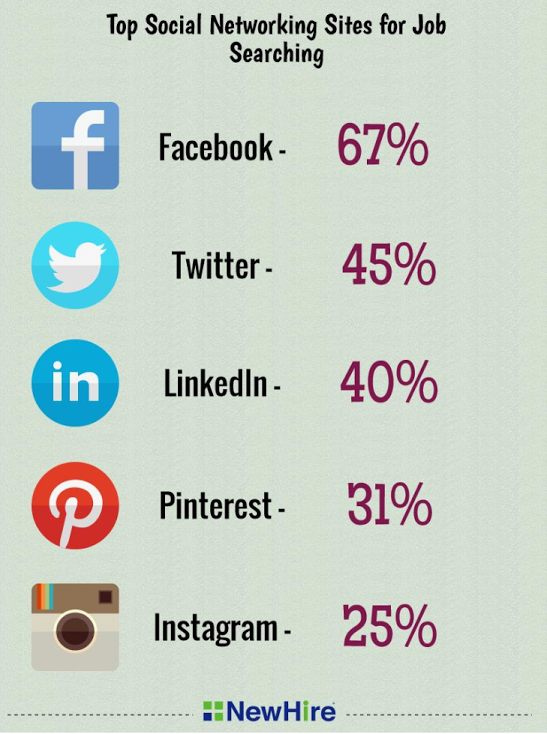
According to a study done by Jobvite here is the breakdown of the number of jobseekers using social media platforms for their job search activities.
Other important reasons to use social recruiting along with traditional recruiting is social recruiting can focus on multiple goals at one time as traditional recruiting has only a single focus. In addition, there are multiple benefits that social recruiting will provide for an organization that traditional recruiting will not.
Social Recruiting Benefits:
1. Find Quality Candidates
Social recruiting will allow you to connect with the potential candidate and get to know them better through social media. For example the type of content and tweets that the potential candidate posts will give you a glimpse of the candidates personality, interests, industry knowledge, etc. This will give the recruiter some foresight to see if the candidate may be a good fit with the company culture.
2. Build a Great Company Brand
Social recruiting can build your company brand and foster a great reputation. Twitter will allow you to boost your brand visibility by engaging with jobseekers through tweets and post positive information about the company which will promote a good reputation. On Twitter your company can share links from your company blog which will provide great insight to the jobseeker on your company culture and industry news. Facebook can provide the candidate the opportunity to see how you interact with customers regarding your products and services. LinkedIn can provide the potential candidate the opportunity to actively participate in industry group discussions which will give them great visibility to recruiters. A person who is social media savvy can be an attractive candidate to a company which the company can envision the potential candidate helping the company brand by contributing to sharing posts and spreading the word about the company’s philanthropy and company initiatives that affect the industries they work in and communities they serve.
3. Help Establish The Company Mission / Promote Company Culture
Social recruiting can bring additional benefits to your organization by helping establish the company mission and promote your company culture. Experienced and educated job seekers tend to place a high importance on a company’s mission. Therefore, if you want to attract the best talent your company mission must be attractive and compelling for a job seeker to want to join your team. The job seeker also must feel like they will fit in well with your company culture. The potential employee will want to feel comfortable in an environment in which they are able to thrive in and successfully contribute to fulfilling the company goals.
What is the future of social recruiting? With social networking being increasingly prevalent users have become both consumers and content producers which will create a higher level of engagement between users and companies. With this higher level of engagement companies and recruiters will need to provide more robust company profiles along with employment opportunities online. To be successful with this new form of recruiting companies and recruiters will have to increase their online presence. This will change your recruiting strategy tremendously. Recruiters will need to switch to an ongoing commitment to recruiting instead of sporadic recruiting practices. This will catapult many recruiters into an entirely new era of recruiting which will change the way you approach recruiting forever.

Things are going great. Candidates are flowing in everyday and you are sorting through as they arrive. Two weeks have now gone by and the traffic is starting to fade. You think, “Oh no!! But I haven’t found the right person yet!” Nothing to fear, you just need to re-advertise! It costs money to find the right person, but in the end it will pay off when you fill an important role in your company.

There are a couple of reasons why you might need to re-advertise, and once you discover that reason, you should consider the best times to actually do the re-posting. It’s not always a quick fix – so you should also consider patience a necessary virtue during this time. Take the time to understand what might need improvement to attract a great pool of candidates.
Here are some reasons and solutions you might need to re-advertise:
1. You’ve advertised, but candidates eventually stopped applying.
Candidates look at new postings first. As your ad ages, it will generate less traffic as newer jobs are being posted. Additionally, your sponsored budget runs out, or your job board posting could have expired. It can be effective to repost to bring your job up to the top and to attract fresh attention for candidates.
Time to Re-Post: If you really need more people, consider re-advertising two weeks after the initial posting – if it is a sponsored budget, start a new campaign as soon as the previous runs out. It is also an option to run an ad on one job board at a time to save money in case you come to find a job board isn’t working. This way you can focus your spending only on what is working.
2. You didn’t get many candidates.
If this happens, you might re-examine your job ad to make sure there is an attractive employee value proposition, compensation listed, and detailed job duties. Your job title might also have an affect on your candidate pool. If your title is too specific, it might be more difficult for candidates to search on. You should also watch out for labeling your job too generically such as a customer service representative, when you really want someone with advanced subject knowledge and extended experience. Also examine the market of the industry to see if it is a good time to advertise.
Time to Re-Post: Take the time while your current advertising is running to re-work the job ad and try an alternative job title.. Get expert help on the compensation range if you’re unsure, then develop a solid employee value proposition. Once you’re ready with this, re-advertise or update your current ads to reflect your changes.
3. The person you hired didn’t work out. It happens.
Sometimes the candidate changes their mind about the position or thinks they are not a good fit. When this happens, especially when they held a vital role in your company, you need to revamp your recruiting to search for the right person
Time to Re-Post: If it’s an immediate need in your company, start advertising right away. See a recruitment expert at NewHire to get you up and running. Take a day before you advertise, to look at your ad once more to ensure you are attracting the right qualified candidates to your job.
Has your company experienced any of the situations above? Let NewHire help you get back on track and set you up with a job ad constructed by an expert and a wide range of advertising options. Just remember, every job deserves the right person!
The last time I wrote about referrals, I hit you with the truth-stick of unlying. Despite all the studies, testimonials, and anecdotes about how amazing referral hires have been for companies, referrals are not magically superior to candidates you get through traditional sourcing methods. The real reason referrals are higher quality hires is because they go through the kind of thorough recruiting process that ends with quality hires. Good systems lead to good results.
It’s the process, not the source of the candidates, that delivers great hires to your company. When employees enter referral mode, they morph into hiring gurus. They source their network for qualified candidates. They evaluate personalities and compare it to their company’s culture. They sell their friends on the idea of working at your company. These are the bases that every company should be covering in their recruiting process, and the employees that are delivering the best referrals are doing this instinctively.

You’re probably spending thousands of dollars on job boards and recruiters to find qualified candidates, yet you have an untapped fountain of mini-job boards and freelance recruiters coming into your office every day. If you haven’t thought about your employees that way, now is the time to start. There’s nothing that job boards are doing that your employees can’t do as well.
CareerBuilder lets you narrow your search by location – your employees can do that. LinkedIn lets you send unsolicited messages to qualified candidates – your employees are free to reach out to their contacts with that same message. Craigslist gets a bunch of resumes delivered to your inbox – your employees can tell their friends how to get their resumes to you. The point is that you’re not losing any kind of control or functionality by including your employees in your hiring process, so use them.
If you’re going to get this started, you need make sure you cover these steps.
1. Let your employees know that you’re hiring.
The team shouldn’t be surprised when Bob shows up on the first day and needs help figuring out where the coffee machine is. You should start the referral process the same way you start the recruitment process: with a job description and a list of requirements. Make an announcement that lists the position and qualifications, and actively request that your employees consider who in their network is a good match.
2. Reward their effort.
Money is the best way of doing this, but information is a close second. Keeping the employees who are participating engaged in the process with updates and feedback can go a long way towards making your employees feel like they were rewarded for their action. Even if you decide on someone who wasn’t their referral, your employees will still appreciate the feedback and honest effort to include them in the hiring process.
3. Make it easy for your employees and their referrals to find the job.
Social media is king when it comes to sharing, so don’t be afraid to use all your social channels — LinkedIn, Facebook, Twitter — to share job postings with your employees, who in turn, can share it with their own network.
Having a formalized referral process isn’t a replacement to traditional sourcing methods. It’s just another tool for you to use to maximize the visibility of your open position, and it needs to be used alongside your job postings on CareerBuilder, Indeed, etc. When the goal of a hiring process is to find the right person for your job, you can’t just rely on one method or one source for candidates. You have to cast a wide net to get as many people into your pool, so that you improve your chance of finding the best person for your job.

During a conversation in May with some of the top executives at small and mid-sized businesses nationwide, NewHire asked them to write down what questions they had about recruiting. Many of the questions we received in response fell into categories that we define in our 6 Step Recruiting Process.
Below is part one of a two part blog series outlining answers to those pressing questions.
Step 1: Preparing to recruit
Q: When making a new hire do you think hiring for experience is of greater value or lesser value than their potential?
A: This is a question that recruiters have argued over for years. When hiring, I think about four things that really define the candidate I want to hire:
1. Work Behaviors
2. Motivations
3. Skills
4. Experience
You will notice that experience was last on that list. Most of the time, we hire people for what they can do and fire them for who they are. A good way to look at the experience vs potential dichotomy is to use the 80/20 rule. I want to make my target candidate the person who has the behaviors and motivations that the job needs and around 80% of the skills and experience necessary.
Here’s why: in order to get someone to leave what they’re doing and come work for us, we have to compel them to make a change in their lives. We have to show them that they are going to earn more, learn more, and do more at my company than they will at any other company. Most of the time, we’re better off hiring someone who can perform the job well enough to start and can grow into the more difficult parts of the role and expand it as they get comfortable.
Q: How do you determine current salary/wage range for a given job/position in a specific region of the country?
A: One of the NewHire Staffing Coordinators, Conor Roach, wrote a blog about this question recently. You can find that here. There are a lot of online resources for this that are inexpensive. A final note in that blog is that you can be broad in the way you list salary on your job advertisement. In doing so, you can ask your candidates specifically what they think this type of job ought to earn. Jotting down their responses in a central location is a good way to benchmark whether the salary you were thinking of paying is competitive.
Q: How do we get our hiring manager and others in the interview process not to hire themselves? (understanding that differences create stronger teams)
A: This boils down to how you prepare to recruit. If the hiring manager is a part of the conversation in which the target candidate is identified, you’ll be able to challenge that person to think about which behaviors, motivations, and skills are important (and that they’re not necessarily the same ones that the hiring manager has). When it comes down to narrowing the candidate pool and making an offer to someone, the hiring manager will be more open to “others.” Defining a process with your team and holding them accountable will trim some of these biases out of the process.
That being said, not all hiring managers are willing to drink the Kool-Aid. That’s something you’ll have to have a serious conversation with them about. Here’s a clip from a pretty mediocre movie that might help with that conversation.
Q: How do you overcome an undesirable location? (50 mile commute from the city)
A: A handful of ways. I’ll knock off “pay more” and “move” from potential solutions, because if those were options, I’m sure you wouldn’t be asking. Not to mention, pay is just one of the reasons people come to work each day. For certain people, it’s not even at the top of the list.
Still, if you have an obstacle like undesirable location to overcome, I encourage you to think long and hard about your value proposition to the candidate and put it in the job advertisement! More on this in a second…
Companies with built-in recruiting issues like yours also need to plan in advance for a more continuous recruiting process, hiring good candidates when you find them and not just when you need them.
Q: How do you appeal to the best people to get them to even apply for a job?
A: Employee Value Proposition. Write it down and put it in the job advertisement. Everything from compensation to work environment to how darn good your company softball team is will motivate candidates to come work for you. I asked one of my account managers what he likes most about working in the office, and he said this:
- He enjoys the people he works with
- There is a place to park his bike indoors
- There’s a shower in the office
Having trouble defining your EVP? Ask your employees! And, request our EVP checklist here.
Q: How to hire not just for the current opening but for the potential to step into the next role?
A: I like this question, because I like the underlying philosophy it reveals. It is often cheaper and more efficient to hire for an entry level position and train your employees into bigger and better roles with your company. If you need to fill an administrative role now, but you want the candidate to eventually move into sales, make some of those sales competencies part of your hiring process today. Add those competencies to the list of skills that your target candidate ought to fulfill. Look at the cognitive abilities of your candidate (by testing them), and seek out their behaviors and motivations in order to identify future leaders.
Later in the process, ask the candidate where they think they ought to be with your company in 5 years. Often, they will tell you if they are motivated to move into a management role, or a sales role, or whatever.
Step 2: Recruiting/Sourcing
Q: Where do you find good qualified applicants?
A: Short answer: I often find them here, among a variety of other places (referrals, etc.)
Longer answer: You never know where or when the right candidate is going to be looking. Sometimes they come referred from someone you haven’t talked to in years who saw your posting on LinkedIn. Sometimes they come from Craigslist. Sometimes they come from Indeed. The point is, the only way you’ll know if your job is competitive enough to appeal to those qualified candidates is if you put it in as many places as you can. If you’re still not finding those qualified applicants, maybe you need to take a few steps back and redefine your Employee Value Proposition or your target candidate. Problems later in the hiring process often stem from problems with the first step: Preparing to Recruit.
Q: Do you recommend different venues for advertising a job based on the type of job that it is?
A: To an extent. LinkedIn and Salesjobs.com are great places to find sales talent, because that’s where sales talent is motivated to go. I often hear, “We don’t want the type of candidate that comes from that website.” I want to combat this line of logic up front.
If you have a tool for sorting through candidates so that you don’t waste time on candidates who are unqualified, what does it matter where they come from? There are CFOs who search for jobs on Craigslist just as there are CFOs who search for jobs on Indeed. No one website is guaranteed to provide only specific types of candidates. My suggestion is always to get the job out to as many places as is feasible and narrow the pool from there.
If the job specification is narrow, industry job boards, LinkedIn groups and association websites may be helpful. These won’t produce large quantities of candidates however they could yield the right one.
Q: How do I train future and current leaders to be good at selecting talent?
Q: How do we train and educate hiring managers to look beyond skill to rather looking at competence and job fit?
A: This is something that NewHire often helps our clients do. You’ll have to lay out a hiring process that you believe in, make it clear and logical so that your current leaders understand it, and hold people accountable on following through on that hiring process.
Our own 6-Step Process is no secret, and it works very well. Most of the time, getting those leaders to understand how to select talent falls into the first step in recruiting, preparation.
Step 3: Screening: Identify Top Talent
There were no questions on Screening talent. That concerns me! Because having an efficient and objective screening process that relies on information about the candidate is important when there are a lot of candidates to sort through. Trusting your intuitions about a person’s resume can often lead to mistakes. Even the President of NewHire misspelled his first name on a job application once upon a time. Are you passing up the perfect candidate because of something small and insignificant?
For more questions and answers on pressing recruiting questions, see Part 2 of this blog post here.
In 2014 Indeed was, once again the biggest winner in the world of Job boards, bringing in 47% of all candidate views and 30% of all NewHire applications for employment. But don’t discount that other 53% of candidate traffic which accounts for roughly 70% of completed applications. This balance of candidate traffic is coming from a combination of other sources, including CareerBuilder, Craigslist, NewHire job board, social media, and array of other smaller job boards. When you’re hiring, don’t miss out on 70% of the possible applicants! Be sure to advertise open positions broadly and take advantage of the power of the internet.
NewHire strives to help our clients make the most of their advertising dollars. For years, we’ve tracked the ability of major job boards to bring candidates to our applications. As we’ve noticed major shifts in job board performance, we’ve adjusted our advertising packages to make use of the most up-and-coming job boards. Most recently, this has been reflected in changes to our most popular ad package.
We look for ways to maximize the value of recruitment advertising by targeting job boards that yield the most candidate traffic. One of the tools we use to learn about candidate traffic is Google Analytics. As an example, the graph below shows total candidate traffic from all sources at the beginning of the new year.

We also have the ability to look at an individual job and say, “You have this many applicants, and the most have come from this job board.” We use this information to allocate resources more efficiently. By spending more money where it counts and less money where it doesn’t, we save time and money.

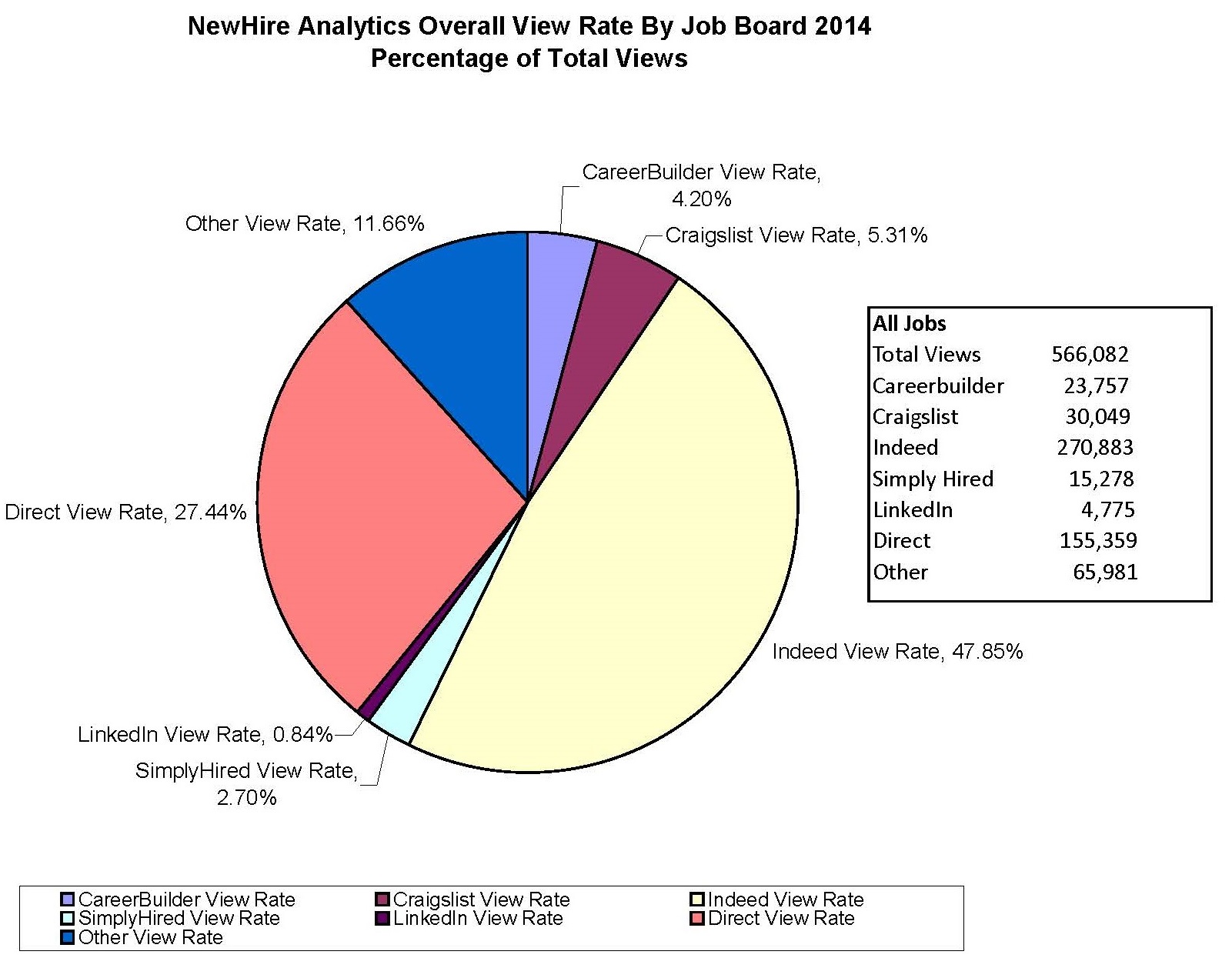
Looking at individual jobs can be useful, but the sample size is small. Let’s look at the candidate traffic from all of 2014. The following graph shows the percentage of views from each of the major job boards that we use in our advertising packages, plus a job board that one of our bigger clients used extensively.
Views from Job Boards
For 2014 data, with over 500,000 candidate views total, the Indeed job board makes up almost half of the traffic. Over the last several years, Indeed has steadily increased its presence as a premier job board. The other substantial pieces of the pie, those labeled “Direct” and “Other,” are more amalgams. The “Direct” category is a combination of candidates who arrive from certain Craigslist ads in low population areas (where we can’t hyperlink directly to the application). Additionally, candidates arriving from the NewHire job board also appear in the “Direct” category. The “Other” category is from the many smaller job boards that re-post ads. Each one brings in a little bit of traffic but all together they make up nearly 12% of candidate traffic.
CareerBuilder and Craigslist continue to run neck and neck in the views they provide. SimplyHired is a board that one of some clients have elected directed a lot of traffic in the past few years. LinkedIn seems to have the smallest piece of the pie here, but there’s a little egg on our face, because some of the 2014 data was temporarily unavailable to us. We are confident that 2015 will show more traffic from LinkedIn.
Applies from Job Boards
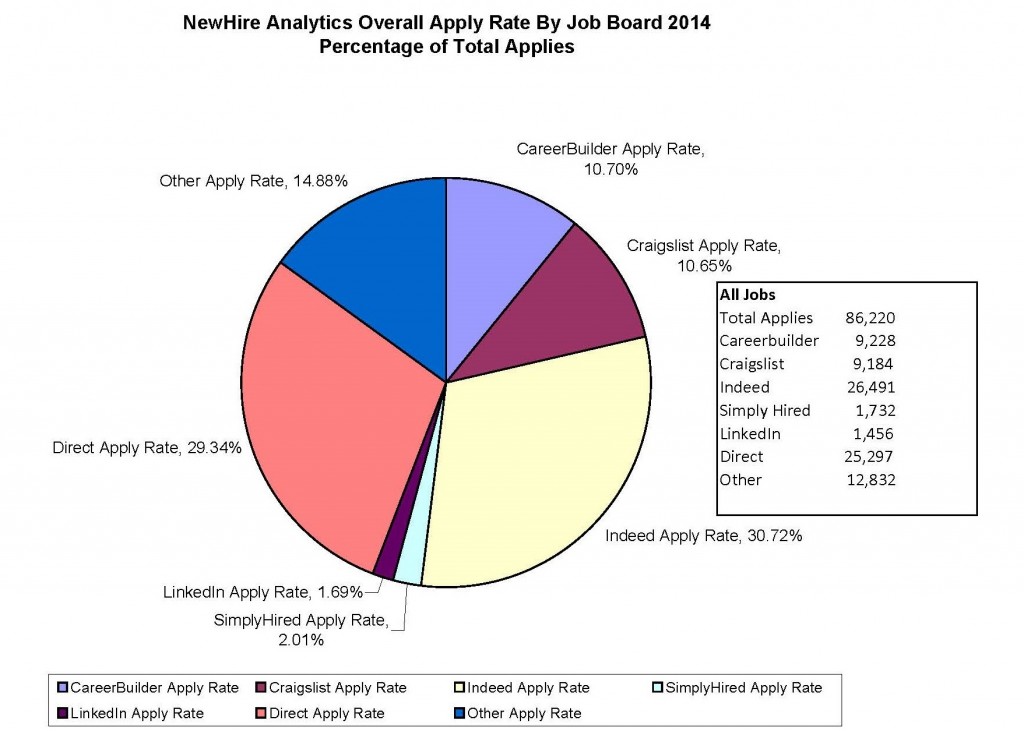
Now – let’s look at applies. The total apply rate for 2014, taken by dividing our total number of views by the number of applicants, is around 15%. Luckily, we can also break down where those applicants originally came from, and get a better idea of how each job board is really performing for us.
With no surprise, out of 86,000 applies, Indeed is still the biggest contributor with around 30%. “Direct” applies are almost equal to those from Indeed. “Other” applies make up around 15% of the pie, a bigger piece than they grabbed when we look at the candidate Views pie chart. CareerBuilder, Craigslist and LinkedIn also have a strong apply rate, despite their smaller percentage of views. It’s interesting to see that CareerBuilder and Craigslist have a strong showing when it comes to candidate applications, as you can see in the Apply pie chart.
With Indeed grabbing the lion’s share of views and applies, is it worth it to keep advertising on the other job boards? Should we just put all our money into Indeed? The answer, in short, is no. We can also look at a job board’s applies as a subset of the number of views from that board, and we can figure out what a job board’s individual apply rate is.
For example – CareerBuilder had 9,228 applies in 2014, out of 23,757 views. That gives it an apply rate of 38.84%. That means almost 40% of people who saw a job from NewHire on CareerBuilder went through our process and filled out an application! This is great when compared to the average apply rate, which is 15%. The graph below shows the apply rate of the major job boards.
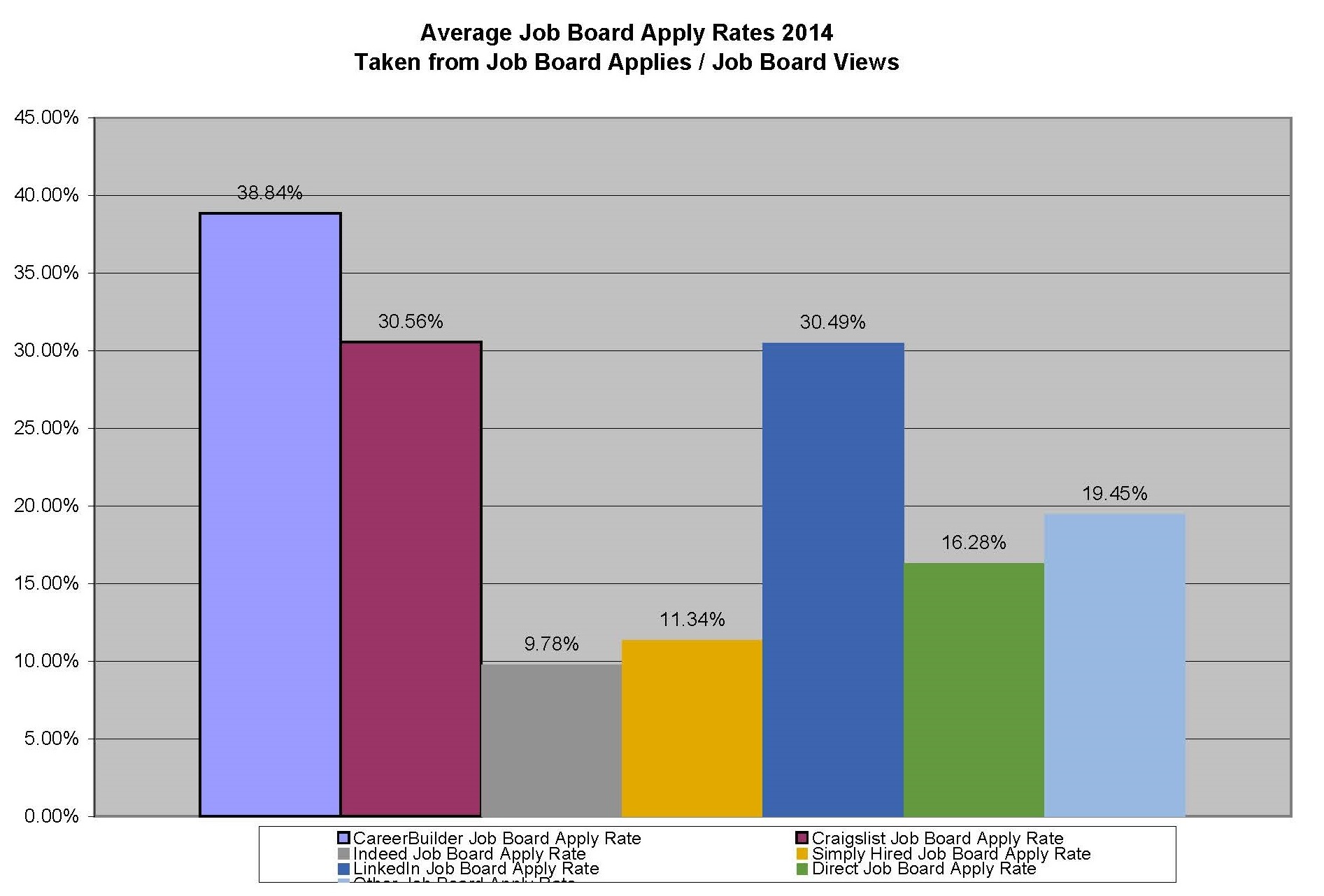
Indeed, which dominates both views and applies, only has a 10% apply rate, which means a lot of people look at our posting on Indeed, but don’t actually apply. CareerBuilder, Craigslist and LinkedIn, on the other hand, show 30-40% apply rates. Other and Direct are also important sources of candidate applications.
So – what does this mean for you?
-
Your job should be advertised on multiple job boards to take advantage of the Direct and Other categories. Candidates search for jobs on many different smaller and larger boards.
-
You should make sure your job is on Indeed, because it’s the biggest board out there right now.
-
Don’t forget to share your job on social media and throughout your network, LinkedIn, Twitter or Facebook, which ever you use. “Other” makes up for a large portion of the application pie.
- The most popular job boards are never a constant. What is producing good results now could be in a decline six months from now. To stay up to date and to receive our initial 2015 data later in the year, be sure to subscribe to NewHire’s blog and email list!

There are good reasons that employers might want or need to have a confidential job listing and conduct a confidential search. Here are some common reasons we hear from employers:
- We need to let the person who is currently in this role go, but can’t do it until we have a replacement in place.
- We don’t want to get calls or emails from every applicant who applies – keep our name off the ad!
- We don’t want our competition to know we’re hiring.
- We don’t want other employees to know the salary range or other details about this position
As an owner and employer I empathize with all these concerns and feel they are reasonable. But (you knew it was coming, right?), there are a few important reasons to think long and hard about the decision to execute a confidential recruiting process. Posting a confidential job listing or ad can have several unintended consequences which need to be considered before the final decision is made.
You may not be able to win the war for the best available talent if the ad is confidential. Loosing a few candidates wasn’t much of a concern just a few short years ago, when very few companies were hiring. But today, competition for candidates is heating up. A confidential job listing can hurt your ability to attract top talent.
Candidates are sophisticated consumers and will do research on the employer, looking at employee reviews and LinkedIn before they invest time in the application process. If the candidate can’t verify what they see in the ad, they may not invest their time and effort to apply. You could get a much lower candidate response rate with a confidential ad and recruiting process.
In order to maintain confidentiality, the ad is likely to be less specific and won’t include identifying information like key products, key markets, projects or attractive details about your work-place and culture. Omitting this information may make the ad less attractive to the top tier of candidates.
You will also miss out on valuable free advertising. Indeed.com (the largest and currently most important job board) doesn’t allow organic ads (free) for confidential jobs. You can advertise on Indeed, but you’ll have to pay for it. Additionally, you won’t be able to post the job on your own website, losing important free access to prospective candidates.
Remember that secrets are hard to keep, even when you run an ad that is stripped of most identifying information. In today’s interconnected, hyper-communicating, social-media-minded, technology-driven, nothing-is-private world, the employer might not remain private; especially if the person you want to replace sees the ad.
We’ve seen it happen! The employee sees their own job advertised and marches into the boss’s office in a huff. “Why are you advertising my job? Am I getting fired?” They demand information, they are mad. The conversation can be difficult, poorly timed and extremely disruptive.
How did this employee even find out? Typically, if you, the employer, are unhappy with this employee’s job performance, they are unhappy too. Unhappy employees are on the job market. Job seekers often set up automated alerts. Notifications of open jobs arrive daily in their inbox, and they recognize their own job, even if you’ve stripped out most of the company specific information.
If you are planning to recruit confidentially and let someone go once the new person is on board, I’d like to suggest an alternative approach. Have the hard conversation BEFORE you start recruiting. This strategy puts you in the driver’s seat, controlling the timing and tone of the conversation. You are more likely to have a better outcome, a better, more amicable separation and likely a smoother transition. Additionally, now you can include company specific information in the ad, improving the likelihood of attracting top talent.
If you’ve thought long and hard, weighing the risks and benefits of launching a confidential search, and you’re willing to take the risks, move forward with the confidential recruiting and post the confidential ad. But if you’re having second thoughts, maybe it’s time to explore an alternative approach.
In the age of the Internet, advertising open positions on online job boards is a great way to find candidates. But is it the way to find the best candidates? There’s no arguing that job boards are magical. They match up candidates who are looking for certain positions with companies who are looking for certain candidates in seconds.
Before the advent of job boards, companies posted ads in the paper or a sign in their shop window hoping they would attract the right person. We’ve come a long way since then. But there’s one lesson from the hiring techniques of yesteryear that many hiring managers have yet to “modernize”. The lesson being that the best candidates often come referred by friends. What’s even better? Asking your friends for referrals is free, easy, and often yields a higher percentage of qualified candidates.

Job boards do a great job of putting job seekers in charge. Candidate A wants a specific position, so Candidate A applies for them—even if Candidate A isn’t qualified.
Asking friends for referrals, on the other hand, creates a degree of separation between the candidate’s desires and the hiring manager’s desires. To state the obvious, if Candidate A was referred to you, then Candidate A is no longer the only person who thinks they are right for the job.
So how do you go about seeking referrals in the age of the “phablet” when everyone is too busy to pick up the phone? Make it easy to share! Here are a few ways to start:
- Post your job on LinkedIn, Facebook, Twitter, and via email.
- Post your open positions on your “timeline” and through direct messages.
- Include a link to the job application in all of your posts and messages.
- Make sure to include phrases like: “Forward this along” and “Anyone who may be successful” in your posts
- Make the message low stakes. You don’t need your network to share it, but look how easy you’ve made it!
- Ask your coworkers, employees, and friends to share the job on their respective networks as well.
Remember, sharing your job through social networks does not replace using job boards as an advertising strategy. You never know where the right candidate is going to come from; and we’ve hired hundreds of qualified candidates by using both strategies. Still, since sharing a job socially only takes 140 characters, why wouldn’t you do it?
When combined with the world of job boards, social sharing will help you fill the top of your recruiting funnel with people who can get the job done. How’s that for magic?
Maybe you have seen them while prowling around Internet job boards. I call them “Do Not Enter” ads. They are job advertisements that focus on turning away unqualified candidates instead of luring in qualified candidates. Postings with this type of job ad jargon meant to keep candidates away are everywhere.
Whether by habit or another reason entirely, hiring managers still use job application jargon to keep certain candidates from applying. The main focus should be on getting the right candidate in the door, not keeping candidates away. They use jargon that is specific to their workplace, “need not apply” statements, and other fence-building tactics to keep unqualified candidates out.
I understand the logic here. If only qualified candidates apply, a hiring manager only has to sort through resumes and applications that deserve attention. But at what cost? Is it possible that the right candidate – the person who is the most perfect fit for your job – is also being turned off by that job-specific jargon?
Shouldn’t we be more focused on attracting the right candidate than turning away the wrong ones?

Luckily, in a tech-world, there is a technological solution. Applicant tracking systems have made sorting through your candidates as easy as a click of a mouse. Modern technology alleviates the concern that you may have to filter through hundreds of resumes. With online job applications, resumes are a thing of the past. Tossing out resumes and using modern ATS technology will allow us to make the best possible hire for our companies by luring in the right candidates and sorting out the wrong ones quickly. Not turning them away, but rather sorting them out.
Ultimately, hiring is about one important thing: finding the right candidate for your job. We believe there is a special candidate out there for every job. And in an era of simple online applications, those candidates are trying to figure out quickly whether they can perform the tasks described in an ad. If your ad is full of jargon, the likelihood is much higher that it will be ignored, and the right candidate for your job will be out of your line of vision.
Open the gates!
If you are stuck between discouraging unqualified candidates and avoiding blocking the candidate from applying, the choice is simple. Open the gates and let as many candidates in as possible. By searching key points in an online application, an employer can save time and money that would have been spent reading through resumes. Then, more time can be spent on the four or five candidates most likely to be the one.
So go back and take a look at your most recent job advertisement. Did it use jargon? Were you focused on making sure certain candidates didn’t apply? Take the “need not apply” statements out of your job description and replace them with statements that get candidates excited to apply.
Give job seekers a few sentences to let them know whether your job is one they would like to work in or not. If I’m a job seeker, what four or five things will I be doing on a daily basis that will add value to the company? What is your company all about? What makes it a great place for me to work? And what tangible things qualify me or disqualify me from competing for this job? Answer those 4 questions in a way that’s easy to understand, and your job advertisement will get you more qualified candidates.
Using technology, the application sorting process is easier, and by extension, the application writing process is easier. Now all your focus can be on attracting the right candidate to apply, which is the best way to get the ideal employee for your company.

Recruiting sales people is hard. It takes time, effort, money, attention, patience, persistence and more. Huh… finding and hiring sales reps takes the same effort and tactics required to sell a product or service. Coincidence or not?
But even if you dedicate yourself to the list above, your chances of making the wrong hiring choice are greatly increased if you fail to follow these 3 keys to recruiting sales people.
- Define the role: which type of sales rep do you want to hire?
Dave Kurlan’s OMG assessment can be configured to screen for 14 different sales roles. Howard Stevens of the Chally Group defines 14 sales specialties. Saying you need to hire a sales rep or account manager is not good enough. Do you mean inside sales of a service? Outside sales of a commodity product? Enterprise sales? Account Management? Each choice has consequences for how you source, screen, assess and hire.
- Don’t hire on experience: favor the right behaviors and motivations over experience
While experience is a good teacher, it is also a poor indicator of future success. When reviewing the experience of candidates for sales jobs, it is rare to find a candidate whose experience is so close to your selling situation that you can use it as an indicator. Almost always, the variables from one company to the next (even when they sell the exact same product or service) are too great to be able to compare apples-to-apples.
The crazy part is that you already know this. When I recently asked 75 business leaders responsible for hiring sales people, how many of their experienced hires were successful, two raised their hands. When I asked how many still included years of experience in their job descriptions, all raised their hands!
- Never give up – never give in: Recruit, recruit, recruit and only hire when you find the right person
Question: When’s the right time to hire a great sales rep?
Trick question!
Answer: when you find her.
But… if you are not looking how will find her? You won’t. Great sales companies recruit sales talent continuously. If you use a great multi-step screening process, using a valid assessment, it does not have to take up all your time.
Make sure that you have the tools, time, authority and accountability to ALWAYS BE RECRUITING.