Archives For Step 6 – Hire ‘em!

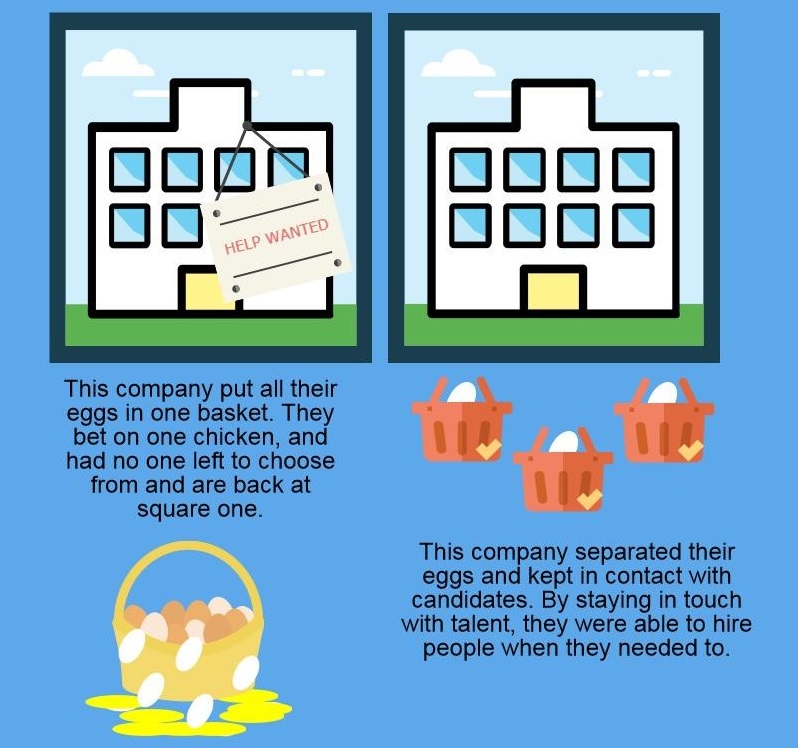
As a kid, the phrase “Don’t put all of your eggs in one basket!” always stood out to me as kind of silly. The idealist in me said, “But if they’re all in one basket, then I can carry them all at once.” And, yesterday, as I stood looking at a dozen shattered eggs sprawled out over my kitchen floor, the idealist in me was very, very silent.

I don’t know if I’ll start  keeping my eggs in more than one carton, but at least now the essence of the adage is not so lost on me. Especially when it comes to your business, employees, or products, having a back-up plan is essential for those things in life that are difficult to replace. As careful as you are in everything you do, at some point, you’re bound to drop a carton of eggs on the kitchen floor.
Step 6 - Sean's Blog Copy

The place in the recruiting process where most employers forget to diversify is during the final offer – Step 6 in our 6 step recruiting process. A business has done all the up-front work necessary. They brought in some fantastic candidates, and found a few that fit the position and company culture. Finally, they choose one. What now? The business sends an offer letter to the top candidate, and when that candidate accepts, the business forgets about the other great talent they just spent months trying to find. Or maybe if the HR Manager is feeling polite, he or she sends the top few candidates an email that says, “Thanks but no thanks, we’ve filled the position.”

 Perhaps you see where this is going. Top Candidate starts on day one, picks things up pretty quickly and is enjoying the company after a few weeks of working there. But then Top Candidate gets a call from her last employer. After some groveling, and a tremendous salary increase, Top Candidate goes back to her old company, and we are left standing in a pile of egg yolks.

In sales, a company would never let a qualified prospect off the hook because they found another qualified prospect to sell to. So why do we throw away good talent so quickly? Especially given the understanding that retaining great employees is so difficult, why throw all of our eggs in one basket?

That moment when your top candidate accepts an employment offer is a wonderful moment. Especially for a business that’s been searching to fill this position for a few months, or even a few years, it can be liberating. But it is also a crucial moment in the hiring process, and one that most small businesses can’t afford to get wrong.

Keep a clear head and check your optimism. Take the good talent you found during the first 5 steps in the hiring process, and just like you would in sales, continue to engage with them. When good talent comes around, remember that “not now” is always better than “no.” A great way to express this to a candidate is as follows:

“We hired a person for this role, but we are always looking to add great people to our team, and throughout the interview process we recognized that you are immensely talented. We would love to add you to our team once we have the capacity to bring on more people. Would you mind if we stayed in touch over the next few months to see if we can do that?”

Imagine hearing that kind of a “no” as a job candidate. The worst the candidate could say is that he or she does not want to hear from you, in which case you are no worse off than you were before. A recruitment process that works like a sales process ensures that once you’ve found good talent, you don’t let them off the hook until they give you an absolute, definite, no. This way, you’ll never be left standing in a pile of cracked eggs with a recruiting emergency on your hands, and your company will continue to add great talent with every hire.

FacebookTwitterGoogle+Share

The finish line is in sight. You clicked send, and the employment offer is now in the hands, or at least the inbox of your future employee. You let out a sigh of relief. You and your team have been at it for months, and you have finally found the ideal candidate for a key hire. I bet you feel eager and excited to move along and get this person onboard. I know that’s how I feel when I get to this part of the recruiting process.

But your heart sinks when you read the candidate’s reply asking for a time to chat about the details of your offer. The finish line seems to be getting further away.  Don’t panic! Here are a few key things to wrap your head around as you launch into the final stretch of the recruiting process.

hand-648443_1920

It’s normal.

Salary negotiations are a normal part of business, just like contract negotiations. A quick Google search on salary negotiation yields nearly 3 million results. Most of the blogs and articles I looked at are geared towards coaching candidates, which suggests that neither you nor I should be surprised when a candidate negotiates salary or benefits.

Take heart, especially if negotiating is part of the job expectations (work behaviors) for the position you’re hiring for.  If negotiating is a job skill you’re expecting (for example sales reps, purchasing managers, or project managers) then you might actually be pleased to see the skills in action. Soon enough the candidate may be an employee using these same strategies on your company’s behalf.

Don’t go in blind.

Craft a strategy and a negotiation plan. Employer’s negotiating strategy can be strongly impacted by the job title and experience level needed.  Every position does NOT carry equal opportunity for negotiation. Consequently, candidates applying for entry level positions, or positions where a larger pool of qualified talent is available, are likely to find negotiations less fruitful. While candidates with high level technical skills or advanced experience or education may find that they have more leverage.

If you expect the candidate to negotiate, have an understanding of your budget and know when you are willing to walk away.  Consider what parts of the compensation package you are able to negotiate.  Total compensation is more than just the employee’s salary, consequently it is advisable for the employer to uncover what the candidate may value and won’t increase the base pay but will build good will and reward top talent for a job well done.

Here are a few ideas for negotiation:

  • vacation days – especially around public holidays
  • work from home options
  • available perks
  • bonuses on success
  • paid training
  • travel
  • mentoring opportunities
  • time to volunteer

Build rapport.

During an employment negotiation you are building a working relationship and laying the foundation and tone for the future. Both parties should behave professionally. Look for common ground that will satisfy the candidate and not break the bank.  Look for win-win opportunities. Consider the risk and cost of losing this candidate and having to go back to square one with recruiting.

Other influences.

The state of the economy, in particular the employment market, may impact the negotiation. A recent report from the Wall Street Journal confirms that the job market is heating up. Non-farm payrolls are on the rise, and unemployment is falling. Additionally, the aggregate weekly hours of all employees is as high as we’ve seen in a decade. While wages are not yet reported to be on the rise, there is considerable pressure suggesting that may change. It’s not 2009 any more and there is competition for top talent.

Candidates are well informed, and knowledge is power. Candidates use a variety of resources to know what constitutes a competitive wage and benefits package in their industry and geography. Candidates also have access to online employer reviews and may use social media to network to current or past employees. The online resources available to candidates have increased substantially and this knowledge can empower candidates when they negotiate.

Remember that every job deserves the right person and part of the process of getting the right person might well include a salary negotiation. This negotiation is a dialogue between two people intending to reach a mutually beneficial employment outcome.

Recruiting Q&A

During a conversation in May with some of the top executives at small and mid-sized businesses nationwide, NewHire asked them to write down what questions they had about recruiting. Many of the questions we received in response fell into categories that we define in our 6 Step Recruiting Process.

Below is part two of a two part blog series outlining answers to those pressing questions. To see Part One of this blog, and the first three steps to the recruiting process, click here.

Step 4: Interviewing

Q: How do I interview to know if someone will fit in sales?

A: The recruiting process for sales reps should mirror the selling process for your sales reps as closely as possible. Be polite during an initial phone screen, but don’t be afraid to tell a candidate, “I’m not so sure this is going to work.” Their answer to that comment will give you an idea of how good they will be at handling objections.

Also, if you think you have the right candidate, give them a chance to close. Forget about the candidate for a day or two and see if they call you to follow up.

Finally, there are a variety of sales assessments available on the market that can pre-screen candidates for you so that you’re only talking to people who will fit in sales. Do some research, think critically, and decide if you want to invest in one that will help you find the right people.

Q: How can you match personality to company culture – during an interview, when people often don’t show their true personality?

A: We try to gauge “personality” or work behaviors, motivations, and personal drive in every step of the hiring process. From the initial application to the phone screen to the in-person interview, collect as many data points as you can about a candidate. If you still think they’re not showing their true colors, be up front with them. Ask them if you can expect to see the person they are presenting once they start with your company. Make it clear that if they’re not, both parties will be negatively affected. Being up front, even this late in the process, can definitely save you some headaches (and money) a few months down the road.

Step 5: Assessing

Q: When hiring for outside sales, how much weight do you give to sales assessments like Sandler?

A: This is very dependent on the job you’re advertising. If it’s a really good job in a talent-rich market, you’ll have enough candidates where you can afford to only talk to the candidates who pass the sales assessment that you subscribe to.
If it’s a really competitive market and you don’t have a wealth of candidates, it’s possible that you’ll have to make some exceptions or extend your search in order to find the right person. If you are having a difficult time getting enough recommended candidates from your assessment, look more carefully at the rejected candidates. Are there some that are close to right and have weaknesses that you can work with?

Q: How can we really find out how they performed in previous jobs?

A: Reference checks are good. But the word “really” in this question makes me think that person who asked might have been burned in the past. Sometimes, a bad reference check just serves as a peace-of-mind facilitator for the hiring manager.

Asking a candidate for proof of success can work. How many times has a sales candidate told you they were leading their previous company in sales and exceeding margins by 40%? A good response to this would be, “Hey, I’ve heard this from candidates in the past and ended up getting burned. I’d like to believe you, but I’d be more comfortable if you provided proof of your success. Can you?” They don’t necessarily have to, but their answer to this question can be a valuable indicator of success.

Step 6: Making an Offer

There were no questions about extending an offer to a candidate. However, things can definitely go awry if you’re not thinking this step through. Making a good offer that reflects the nature of the conversation you’ve been having with your top candidate is important. Be prepared to negotiate, though, especially with top talent.

Other

Q: What’s the path of least resistance in recruiting, no matter the position?

A: I’m tempted to say, “Call NewHire!” Look, recruiting is not easy. It takes planning and execution, just like everything else in business. Easy processes with bad tools yield less than desirable results. You’ll pay for those results down the line.

Doing some work up front to define your target candidate and employee value proposition, write a killer job advertisement, and advertise it widely will get you good results when it comes time to narrow the candidate pool, interview the top 10% and finally make an offer.

The path of least resistance is still going to be difficult, but it will also be worth it. Great companies big and small have one thing in common: they put a great deal of energy into hiring well. They understand that in order to get the bus going in the right direction, you have to have the right people on that bus. That means hiring well should be hard. But it will be worth it.

Teamwork is so important that it is virtually impossible for you to reach the heights of your capabilities or make the money that you want without becoming very good at it.” –Brian Tracy

improving company culture

Once you have completed the hard work of recruiting and hiring it is now important to create, or expand on the essential – and sometimes overlooked – process of team building. A team that garners an attitude of trust and respect is tantamount to success.  If your employees know that they are all working toward the same goal, the individual efforts can quickly turn into fulfilling group collaborations.  Here are some suggestions for improving company culture to bring your team together.

Physical activities

The engagement of physical activities with your employees is an excellent way to not only promote health and wellness, but also promote the bonding that is unique to exercising with others. The experience of joining together in this setting can easily translate to the work environment and allow for your employees to trust each other in a different way.

The range of physical activities is extensive and can range from an office hike (if you have a smaller team) to large interdepartmental softball teams. For example, the J.M. Smucker Company holds bowling nights and softball games for its employees, and TIAA-CREF employees can play up to six sports on site. Getting people to work together on teams outside of the workplace is awesome for improving company culture. 


Attend a Speaking engagement

There are a multitude of speakers that discuss topics that can be transformative professionally and personally. Choosing a speaker that will educate your team in your field or that will enhance their personal lives is an excellent way to join together and encourage collaboration. A great way to gauge interest is to poll the work-force to see what kind of speaker or what specific speaker would be most appreciated. Successful personal and professional speakers include Eric Thomas, Ray Lewis and Steven Covey.
 

Surrounding area tour

Touring the town or city that you live in by boat, bus, or walking is a great way to get to know your environment with your employees and explore common areas of interest. It is especially welcoming to employees that you have relocated or that are new to the area. If you’re in a city, visit the historical district. If you’re in a rural area, take a farm/woods/park tour.


Scavenger Hunt!

Working together on a scavenger hunt is an excellent way for your team to collaborate as well as allow individuals to reveal their different skills sets under the high pressure circumstances. Everyone’s strengths and innovations are clearly on display during this challenging and surprising game, and it is a great opportunity for your team to gain new perspectives of one another.

The most comprehensive scavenger hunts ask participants to take photos of certain items with team members and give points for each photo taken. High scoring photos might include, “Team members with a Speed Limit sign that is not a multiple of 5.” Low scoring photos might include, “Team members assisting someone with their groceries.”

For a great Chicago Scavenger Hunt, please visit NewHire’s valued client, Windy City Fieldhouse.


Supporting your team members personal endeavors

If members of your staff are pursuing acting, sports, or another personal hobby, attending their event is a great way to recognize who they are as individuals outside of work, as well as build camaraderie. A show of appreciation for your team after work hours is a great reflection on how much they are a valued not just for what they do but for who they are.

 
Not only does team-building drive growth and productivity, but it also makes hiring and recruiting much easier, as it helps your company gain positive reviews on websites which are often visited by job applicants. These are a just a few examples on how to foster team work in your organization. Do you have any fun things in mind for improving company culture?

blog post


Searching for a job is a lot of give and take. Especially if you are brand new to the workforce (see: the author of this post), it can be a lot more giving than taking. After all, you are leveraging a limited amount of experience against high ambitions.

“What’s your expected salary?” they ask, and you mumble back something about how your roommate with the same level of education and skills is making enough money to pay rent and buy a venti mocha every day, but you might settle for just the rent.

You apply, apply, apply and for every 30 applications, you hear back once. And if you are lucky enough to make it through a phone screening and two interviews, you have to wait. Whether two hours or two days, that wait can be nerve wracking. But if all goes well, you are hired.

Truth be told, the entire process is daunting and long. Not to mention, if you are anything like me, you may have jumped the gun on signing a lease and moving out of mom’s house before you had a job locked up.

Luckily, there are a few steps you can take that make finding the right job — and helping the right job find you — easier.


Let them see you:

A lot of job applications offer questions that are meant to weed out unqualified candidates. These screening questions allow hiring managers to see only the applicants who have the characteristics they find most important. They save both parties — employer and candidate — time and money. When faced with such questions, it is important not to sell yourself short. If you are applying to be a reporter for a newspaper and they ask for years of reporting experience, don’t leave out those four years in college you spent on the school newspaper. Experience is experience.

That being said, be honest. In the same way that you feel you deserve the right job, the companies with which you are interviewing deserve the right employee. If you aren’t qualified for a position, don’t waste your time or the time of the company by exaggerating or embellishing your skills.


Let them hear you:

If you have been invited for a phone interview, or better yet an in-person interview, wake up at a reasonable hour and prepare your mind and body for the day. Speak loudly and clearly. Be confident. I am certain I was screened out of the first job I received a phone interview for because I woke up just as they were calling and sounded groggy and slow. After that, I started to treat my job search as if it were my current job. I woke up early each day, got the coffee brewing, and went to work searching for a job.


Let them know you care:

If you’re unemployed or working a part-time job, but you are looking for a full-time position, use your downtime wisely. Prepare for common interview questions like:
What are some of your strengths and weaknesses? What was something you liked or disliked about your last job? Where do you see yourself in 5 years? Also, take some time to research the companies you have applied to. How do they serve their clients? How do they make money? Do they do any philanthropy?

This allows you to give thoughtful responses that might set you apart from your competition. When you get an interview, make sure to follow up afterward and let the company know your level of interest.

If you find that you have a lot of downtime, take some online tutorials on different skills that might be useful at the jobs for which you are applying. While I was job searching, I learned HTML programming and Microsoft Access for free on the Internet. Through those tutorials, I was able to put new skills to use in my job at NewHire.


Know what you’re looking for:

This is perhaps the most important thing to consider. When I was looking for a job, I started out not really knowing what I was looking for. I was thinking that I needed a high-paying position at a huge company, because I was a college graduate, darn it. As I continued searching and considered my past employment, I realized that the best thing for me would be an entry-level position where I wanted to live (Chicago) at a company that would let me express my passions for writing, interacting with the people around me, and maybe even telling a joke or two along the way. I wanted the room and freedom to grow at a company that valued growth.

When I started thinking about what I wanted to be doing each day, my job search narrowed significantly. Enter NewHire, who screened me, called me, interviewed me, and hired me after a few days of nervous wait time. Now I’m talking with people from all over the United States, writing blog posts, working on a team, and, yes, even cracking a joke or two. How’s that for a job search?

If you think you are ready to put yourself out on the employment market, check out our job board. We update it constantly with new positions available all over North America. If you are more of a social media guru, check out our Twitter and Facebook pages for frequent #hiring updates.

The Hot Standby

Chuck Smith —  April 29, 2013 — 3 Comments

6829510801_7a8c058e92

Have you ever been caught in a situation where events out of your control left you with few options? An important supplier fails to deliver on time. A business partner’s promise is broken and you’re left picking up the pieces. A key employee suddenly quits. At one time or another, it has happened to us all.

That’s why a piece of advice I heard recently from Jim Dolan, CEO of The Dolan Company, struck such a nerve. He said, “Do the extra work to have a Hot Standby.” Dolan’s example was about an investor who made promises to him and then at the last minute changed the terms of the deal. Since Jim’s investment banker insisted on “hot standbys,” they were able to close the deal with a back-up investor on the same day.

At NewHire, the examples we see of this overlooked necessity fall into two broad categories:

  1. Business owners who run into trouble when a key employee leaves with no one trained and ready to take that person’s place, and;
  2. Hiring managers who slow down or stop the recruiting process because a single well-matched candidate is identified.

In today’s business world few small and mid-sized companies (SMBs) have the resources to maintain a team of reserves. The GE model of management (where backups are constantly groomed for each position) is nice to talk about but not a realistic option for most SMBs.

Here are some suggestions more suited to most mid-sized businesses:

  • Cross train wherever possible. Make sure that your employees are able to do more than one job, paying special attention to the most critical job functions.
  • Maintain a pipeline of candidates, even when you are not hiring. You may not have the resources or the need to hire anyone today, but keep your eye out as if you do. Always be on the look-out for talent and create a method for keeping track of who you might like to have on your team in the future.
  • When you ARE actively hiring, schedule a second set of first interviews, even when you have identified a well-matched candidate in the first round. This second round of first interviews is an important way to have a hot standby for both short and longer term hiring needs.

When you are in the midst of recruiting for a job, don’t stop the process until your new person is on board. Too often we see employers say things like, “I like Terry, let’s see how the interview process goes before we meet anyone else.”

If we apply the concept of the Hot Standby, Terry is still the number one candidate. We just keep talking to candidates two, three, and four, until we know Terry is on board. What if Terry gets a better offer or a counter offer, or has a terrible 2nd interview or a no-go reference? If the recruiting process is put on hold waiting on Terry, it can add weeks, even months, to reach your desired outcome.

Jim Dolan’s Hot Standby concept is so powerful in recruiting and hiring. Our best-practice recommendation: keep the top candidates engaged all along the way and continue to develop and screen the candidate pool for other top talent. Having options takes additional work, but it’s often worth the effort!

Dolan was part of a nine-member panel put together by Bob Jordan to celebrate entrepreneurial success in the Midwest and the publication of his book: How They Did It.

We get anxious when hiring a new employee – we want our candidate to start right away so we can move on to the next thing on our to-do list. But first we need the candidate to accept our offer of employment. So how long should we wait to get an answer back?

Well… it depends.

While a standard turn-around time to respond to a job offer is 3-5 days, the answer depends on a couple key questions we need to ask ourselves before we make an offer of employment:

1. How urgent is this hire? If the company needs to make an urgent hire, it’s acceptable to give the candidate a near term deadline for responding. For example, make the offer on a Monday or a Tuesday, and ask for a response by the end of the week. Alternatively, make the offer on Thursday or Friday, and give the candidate the weekend to think it over. Either way, set a firm appointment time for a follow up conversation.

2. Is the candidate considering other offers? The job market IS heating up in some fields, and top candidates are getting multiple job offers! If we suspect that the top pick is handling multiple offers, it’s important to act fast. Give the candidate a specific date to respond. If they are considering other offers, they’ll most likely ask for longer to consider the offer. If the candidate is worth the risk of waiting, respect their wishes for additional time.

3. Do you have a “hot standby”? If you have a strong viable number two candidate, you can put a bit more pressure on your top choice. In the meantime, keep a conversation going with the hot standby. If you don’t have a reasonable second option, continue your recruiting process and develop your pipeline. (Read more about “hot standbys” here.) 

Asking for a response within 48 hours is not considered best practice. The candidate needs time to make arrangements and think the offer through. If the candidate makes a quick decision they come to regret, it might also hurt the employer and the business. Studies show that employees who are unhappy are not as productive at work, take more sick leave and happy employees tend to stay in their job twice as long.[1]

Every situation is different – but it’s important to think all of these factors through before making an offer of employment.

I’ve been reading a lot lately about the importance of Checklists. I was asked recently if I had a Checklist for Hiring. I do and here it is:

10 critical things to know before you make an offer.

Ask yourself, Is the person…

1. The “Best Available Talent”
2. Legally eligible (has to provide proof!)
3. Reference and background checked
4. Able to work in the place(s) and for the time required
5. Pleased to accept the compensation offered
6. Able to do the work…
a demonstrated capacity (not experience) to do the job
7. Able to learn and adapt
8. Time Horizon minimally acceptable (likely to do the job for x years)
9. Going to get along with others in your environment
(NOT a recommendation for a homogenous environment)
10. Someone you are looking forward to seeing everyday

Love to hear what you think. Did I miss any? Do you disagree with any?