LinkedIn is becoming a great place for candidates to search for jobs – earning their reputation as the “world’s largest professional network.” We have been experimenting with the effectiveness of using the “share” button to spread the news about job openings with our clients. Our data found that the more people who share your company’s job, the more exposure it will get.
Taking a sample of 26 jobs posted on LinkedIn (from 8/20/12 to 9/20/12), with an average of just 2.2 shares per job, we saw an average of 95 people viewing each job.
However, taking a sample of our 64 jobs (from 6/20/12 to 9/20/12) we had an average of just over six shares per job and an average of 196 views for each job that was posted. Additionally, the first set of data average just over 10 apply-clicks per job, whereas the second averaged 29.
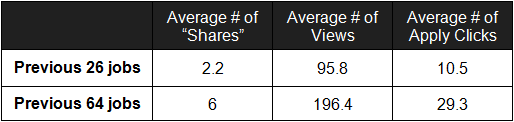
The data show the number of apply clicks and views is directly correlated to the number of shares.
Types of jobs that don’t draw well with social media advertising
Obviously there are factors outside of how many times a job is shared. The job itself is paramount: A bad job won’t get candidates even if everyone knows about it (everyone will just know it’s a bad job). Another factor is what type of job you’re posting on social sites. Typically, blue collar jobs or hands-on jobs will not draw as well on the internet. The same goes for face-to-face jobs like waiting tables and bartending. The reason for this simply stems from the type of person who is being searched for – an employer must know who the ideal candidate is in order to know how to reach that person.
Types of jobs that do draw well on LinkedIn
We’ve found that management-level positions advertised on LinkedIn tend to do draw well. The reason could simply be that management-level employees understand the importance of having professional networks, and thus use the website regularly. In addition to administrative positions, which are wildly popular everywhere, the most commonly applied for position level was management.
Sales positions have also performed well on LinkedIn as it is a rapidly changing/moving industry, and those candidates are prone to using professional networks to connect with prospects, leads and other companies. Sales reps are always on the move and are always needed somewhere. As such, it comes with the territory to stay up on technology and be active in finding new ways to survey the sales landscape. Additionally, sales representatives know that LinkedIn is an effective sales tool. It is useful to find information about a lead before making a call. As such, sales reps are already using the site, so it makes sense that they’re reachable on the site.
Promoting on other social media sites
As far as the other social sites, they are far behind LinkedIn from an employment standpoint. Facebook boasts targeted pay-per-click advertisements and various company-apps for job-searches, but there isn’t a go-to platform to utilize the network. In the same vein, Twitter is good for sharing jobs and telling people that they’re available, but it does not yet offer a way of knowing how effective it can be as a job-promotion tool.
Takeaway
As you can see, how effectively sharing your jobs on Linkedin has a significant effect on the amount of candidates who will apply for the job. Make sure to encourage your employees to share your company’s jobs as it will extend the reach of each advertisement.
Have you used social media to promote your job ads? How has it worked for you?
Image Credit: http://www.flickr.com/photos/coletivomambembe/