Archives For Step 2 – Build a Candidate Pool

Mad computer

In the digital age, consumers have more information available than ever before. One increasingly popular source for such information is opinion and review platforms with non-professional/user-generated content. Whether it’s ranking a restaurant (Yelp), movie (IMDb), book (Goodreads), or even college professor (RateMyProfessor), it has become more and more frequent for everything and everyone to fall under anonymous Internet raters’ scrutiny.

And while much has been written about employers’ ability to use social media to check candidates’ backgrounds, the web has also enabled job seekers to research prospective employers based on past and current employees’ reviews. These employer reviews can play a major impact on the recruiting process, whether positive or negative, and are becoming increasingly important to track when looking to a make a hire.

Where are jobseekers going for Employer Reviews?

The two largest employer review websites currently are Glassdoor and Indeed. While smaller employers could have zero to a few dozen reviews, large employers, such as Coca-Cola, have over a thousand. On both sites, current and former employees rate companies on a 1 to 5 star scale.

Glassdoor allows reviewers to get a little more specific and asks reviewers to rate companies’ Culture & Values, Work/Life Balance, Senior Management, Compensation & Benefits, and Career Opportunities. Both sites allow reviewers to leave comments to accompany their rating, which is frequently where the most insightful information resides.

When a possible applicant uses these sites to research an employer and sees an overwhelming number of negative comments, their desire to spend time applying for that position shrinks. No one wants to work for a bad employer.

Do these reviews really have an effect on recruiting?

How frequently have you seen a restaurant proudly displaying their high Yelp or TripAdvisor rank? Some service sites put enough credence in user reviews that they use them for quality assurance.

For example, Uber, an increasingly popular transportation start-up does not allow drivers who fall below 4.7 stars to continue to drive under the company name. While goods and services providers have known for a while that online review sites affect business, when it comes to recruiting, many small- to mid-sized companies may overlook online reviews’ influence on attracting applicants and hiring people to fill positions.

When consumers turn into candidates, they don’t stop utilizing the web for information gathering. Time Magazine reported that nearly half of employees polled in 2013 said that a company’s online reputation matters as much as the job offer.  For personal evidence- all three of the most recent employees at NewHire (myself included) looked at online employer reviews during our job hunt. Finally, one possible extra perk keeping high reviews: saving money. Most candidates are willing to accept a lower salary if company reviews are favorable.

In their 2013 Candidate Behavior Study, CareerBuilder discovered that 67% of the over 5,500 job seekers polled said they would take a lower salary at an exceptionally reviewed employer online. That’s a lot of people.

Employer reviews are key to making good hires at the rate you want. So now that you know how important they are, what can you do about poor reviews? Stay tuned for part 2 and I’ll let you know.


keywords for recruiting

Source: http://www.flazingo.com/


It’s no secret; one of the toughest parts of recruiting is finding the right candidates, and helping them to find you. According to a recent report from the Bureau of Labor Statistics, there were 4 million open jobs in March of 2014! With all those options for candidates, it’s important to do everything in your power to make the job you’re hiring for stand out in the crowd. Using strong keywords in every recruitment ad is one way to make it easier for the right candidates to find your ad. So how do you know which are the best keywords for recruiting the type of person you want?

The goal of an effective recruitment ad is to help candidates who are a good match for the open position find your ad and apply for the position.  There are several factors other than keywords which make an ad successful. You can read the keys to successful recruitment advertising in our other blogs here.

Today, candidates use a variety of websites to find open jobs.  The number of job boards and search options available to candidates continues to increase. Candidates use job boards (Indeed and CareerBuilder etc.), search engines (Google, Bing and Yahoo) and social media (Facebook, LinkedIn and Twitter).

Including keywords in a recruitment ad is a little like doing SEO-lite. Using keywords for recruiting will improve the likelihood that the ad is findable on the web. Keywords are like a homing beacon, attracting the right candidates to the open position. So what are the best keywords for recruiting to include and how should they be used?

Keywords are the common words or phrases that provide information that is most important to candidates you want to attract – don’t use company jargon or esoteric, cryptic, or otherwise confusing terms. Your top candidates will focus on what’s important to them when they’re searching, and the more keyword categories you include the more you increase your chances of reaching those candidates.

Keywords fall into several different categories that include all the primary aspects of your open position: Job Title, Location, Salary range and perks, Industry and product specifics are all important. Put yourself in the shoes of your ideal candidate; imagine how they will be searching the web to find their next job.

The job title is super-duper important. If you use the wrong job title, the right candidates might not find the ad. Worse yet, the right candidate might not identify the job as appropriate to them. For example if you call the job “Customer Service Representative” but expect candidates to be able to share accounting expertise with customers when providing service – you might find that you aren’t able to build an appropriate candidate pool. Once you’ve decided on the appropriate job title you can include a few variations peppered throughout the ad text.

Inducing industry information is also important. All sales jobs are not the same. After all, selling specialty software to legal firms might be a tad different than selling cars on Parkway Avenue, or selling capital equipment in the manufacturing sector. Include the industry of the company, and the types of products involved. Find ways to get that information into the ad more than once.

Salary, benefits, and perks count too. You might be surprised how often candidates search for “sales jobs with company car”. Be sure to tell the candidates what’s in it for them, be as specific as possible. You might even find two places to include this information in the ad, for example include compensation information once in a sentence in the first paragraph of the ad and once in bullet point list later in the ad.

Geography also matters. Does this position require the best candidate to be at your work site or office? At a client work site? At their home office? Travel to a different location each month? While big box national retailers may have openings in every city – smaller employers likely have a more specific work location in mind. Let candidates know where they will be expected to work. And tell them twice!

Repeat keywords a few times in the recruitment ad text. But be careful! Don’t just repeat the keywords again and again at the bottom of the ad. Instead use the words in context, a few times. Use similar words, variations, synonyms and common abbreviations to add variety.

Keywords should be included in your recruitment ad to help candidates find the dream job you are advertising. Use keywords in your recruitment ad to grab the attention of your ideal candidate AND to help them find the job using job boards, or by Google searches. Use keyword several times through out the recruitment ad to be sure that where ever your ideal candidate is searching for their dream job – the job ad they see will be the one you are recruiting for. Lastly, if you are planning to share the job by social media, don’t be afraid to use the #hashtag (#hiring #location #industry #jobtitle), it can only help get your job found.

Follow along as we hire for open positions at NewHire.

We’ve been steadily interviewing for a couple of different positions at NewHire, but now the urgency of the need has increased. We have you, our wonderful clients, to thank for that. So, thank you!

We thought it might be interesting and informative for you to follow along as we hire (and we thought you may know someone who would be a good fit). We are currently in the process of building a candidate pool for several different roles. Here are the jobs we are looking to fill:

Staffing Coordinator:

As you know, Staffing Coordinators deliver the NewHire recruiting process to our clients. We have an internal, written job description which details reason the job exists, the duties, responsibilities and rewards of the job. Actually we have three of those job descriptions, because each Staffing Coordinator wrote their own job description. Now we have a NewHire application here. 

Account Manager:

This is a sales role. The job description focuses on learning NewHire products and services and learning our clients’ needs and wants. Our goal is develop Account Manager into recruiting experts. We distinguish the role from the job title “Sales Representative” because Account Managers don’t cold call. They do go out on sales calls, sell over the phone, network, attend trade shows, do demonstrations, write blog posts and provide post-sales support to clients. We are looking for two people and you can see the NewHire application here.

Administrative Reception:

This is our entry-level position and we have promoted most of our current staff from this role into others in the company. We look for the “best available talent” measured by intelligence, behaviors, motivations and aptitude. If you know a recent college grad interested in a growing web-based software and service company, please send them here.

Building a candidate pool is no easy task. It’s important to advertise to the right people, get a good pool to choose from and then screen them to see who you want to interview.

Each process will rely on NewHire to advertise, source and screen candidates. We’ll phone screen the people who are the closest fits and give assessments to the best of the phone screens.

Follow our blog for more updates on the process. We look forward to introducing you to the newest members of the NewHire team once we have finished building a candidate pool, screened our candidates and selected the best person for the job, because we believe every job deserves the right person.

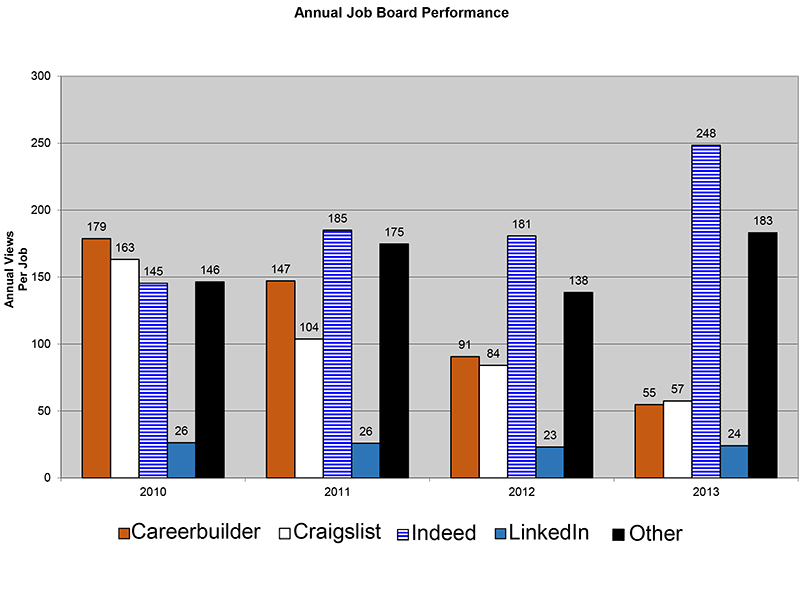
Today’s jobseeker landscape has vastly changed from how it appeared only a few short years ago. Job boards like HotJobs and Monster.com have all but disappeared from our regular referral sources, while new boards like Indeed have exploded in usage. Job seekers tend to sway in what boards they favor like teenage girls to the newest boy bands; what was trendy four years ago is no longer “in” and what is popular now might not be in the future. The importance of social media as a source for jobs seekers is reflected in LinkedIn’s steady presence on our lists of preferred referrers.

During the past four years, Indeed experienced explosive growth, nearly doubling the number of annual job-seeker views per NewHire job since 2010. CareerBuilder and Craigslist have declined steadily. And for the first time ever in 2013, Craigslist edged out CareerBuilder. LinkedIn remains a very steady board, providing a stable number of job- seeker views to NewHire jobs each year.

CareerbuilderG1ReferralsPerJob-1- Large Key

In 2010 CareerBuilder was the top performing job board with Craigslist in a clear second place. Today the lay of the land in recruitment advertising is changed. Indeed is the clear winner.

But there are other players that can’t be ignored. In second place, receiving the silver medal, is a category we call “other”. It is made up of 100s of Niche job boards, employer careers pages, emailed jobs and Google searches. This category is like the relay team – energizing the recruiting landscape with many less well known players. Together these sites play a key roll in attracting candidates. Is next year’s big winner hiding in this category? We don’t know, but stay tuned because as surely as daffodils bloom in spring, the recruitment advertising market will change in the coming four years.NicheJobBoards_NumberOfBoardsPerYear

The rise of these niche job boards is part of the reason why things are not completely doom and gloom for CareerBuilder. While it may not contribute as many candidates as Indeed, it does play an important part in the “spider web” effect of spreading posted jobs to its partner sites such as Headhunter and MoneyJobs. Combined with our highest application rate of 38%, there are still compelling reasons to keep CareerBuilder a part of your recruiting process.

More about the data and how we get it:

As a provider of applicant tracking software and recruitment advertising services to companies with 1000 or fewer employees, NewHire is in a unique position to provide independent data on job board performance.

In the past, we’ve blogged about the importance of Indeed as a source for candidates – the people who actually apply for the job, not just job seeker views. In the data shown here we’ve expanded– going back four years – to get a more general look at how both Indeed has risen up – and CareerBuilder and Craigslist have tumbled.

Below is a table showing the detailed results of this four year effort.

table info reformatted_ecantave

First – let’s look at the number of unique NewHire jobs each year that received views from key job boards including CareerBuilder, Craigslist, Indeed and LinkedIn. We’ve also included the category of “Other” as a catch all for many smaller niche boards and our own NewHire Job board. Every NewHire job with a job-seeker page view sent by one of these boards was counted.

As the employment market has steadily gained steam, you can see the number of jobs advertised on each board has steadily increased.

So, with increasing number of jobs advertised, you might think our referral numbers also show a corresponding increase, correct? Not according to the data we examined. CareerBuilder shows a small gain before sliding in 2012. Craigslist, on the other hand, rises through 2012 and then falls off in 2013, while Indeed explodes in popularity, growing each year. The only job board to actually follow the pattern we expected is LinkedIn, which showed modest increases in traffic each year as more jobs were added. Finally, the last column of the table shows the annual number of referrers per job. CareerBuilder and Craigslist lost the most ground, and Indeed gained the most over the past four years.

What does this really say about Job Board performance?
• Make sure your job is featured on Indeed
• Don’t discount advertising on other boards as they bring views, candidates, and links that all help drive the category called “other”.
• Take advantage of the interconnectivity of the web and social media sharing to help us help you get the right candidates!

Stay tuned as we delve further into that mysterious “Other” category in future blogs!

iStock_000007455150Small

Having experienced thousands of job openings and millions of candidates at NewHire, one lesson is clear: Every recruiting project moves from the “ideal world of the job description” to “the real world of the people actually interested in your job.”

Perfect candidates are an extremely rare breed. This Harvard Business Review article (link: http://blogs.hbr.org/2013/01/dont-hire-the-perfect-candidat/) calls them “purple squirrels.” We tend to call them “flying mermaids.” However you think of them, there’s nothing wrong with finding the perfect candidate — if you can do it in the time frame required to meet your business objectives. When you find a candidate like this, think of it as a happy accident.

As in most of life, timing is everything. The bigger your hurry, the more compromising you must do. The higher the stakes, the more careful you feel you must be. Let’s look at two real-life scenarios to illustrate what we mean:

Scenario 1.

You have an opening for a sales representative (I know… you always do) on your team of five. People are a bit stretched covering the open position, but not impossibly so. Your Sales Manager is spending measurably less time coaching and more time selling, so this hurts the overall sales effort. Given the cost of the hire, the initial training and a significant ramp-up time, you’re looking at an investment of $50,000 to $60,000. You’ve seen six candidates who have been through a multi-step recruiting process, including a positive result on a sales assessment that you believe in. You’ve been at it for 90 days. Each of the candidates has significant pros and cons. Do you pick the best of the bunch or keep looking?

Scenario 2.

You own the business and it has been good, growing, and modestly profitable. You’ve been at it for six years and now you are thinking it’s time to bring in a General Manager or COO who will help you to the next level. You want to add more professional management experience to your organization. You want time to work on new products and spend more time with customers. People tell you that you’ll have to pay $110,000 to $130,000 to get the right person. Having mentioned your interest to a few colleagues, referrals are trickling in and you’ve met with three candidates. You liked one of them a lot, but she’s in demand and likely has other offers. Do you take the plunge and hire her?

Here are our answers:

Scenario 1: Pick the best of the bunch and get a sales rep hired.

Yes, it’s a significant investment and you want to get it right, but the cost of doing nothing exceeds the risk of hiring the wrong person. It’s difficult to calculate lost opportunity, but you know it’s there. Without a fully functioning sales machine it’s difficult to grow. Use 30, 60 and 90 benchmarks to measure whether your new hire is on the path to success. Keep sourcing, screening and interviewing candidates… there’s never a wrong time to hire a purple squirrel sales rep. Build the cost of sales rep turnover into to your annual budget so that you don’t fret every time a sales rep fails… it happens.

Scenario 2: Slow down! Back up and start over.

We are not opposed to “opportunistic hires,” but the business owner in this scenario has not spent any time clearly defining the role and responsibilities, nor have they thought about the behaviors and motivations that the GM or COO job would reward. What is the owner’s behavior profile? Should the new hire have the same kind of profile or should it be different, filling in leadership and management gaps. Would a hire coming from a large organization with a strong history of implementing corporate best practices be a good idea? Is the referral he liked, “the best available talent?” He doesn’t know WHO he doesn’t know, so expand the pool of candidates dramatically. Kiss a lot of frogs. It helps you identify when you’ve found your prince.

How many people do you interview for each position before you hire?


combinationSocial media can be a valuable tool in any small to mid-size company’s recruiting process. Not only are most sites free to set up, but they can also be a key source of finding candidates. In fact, 78% of recruiters reported to Jobvite that they used social media to make a hire in 2013 .

Here at NewHire, we are encouraging clients who utilize social media platforms to share their application on their own accounts. This can include both your company’s accounts and even your own personal ones. By sharing your open positions with those in your social media circle, it will help target individuals already connected to your industry and help draw new candidates to the opening. In the case of personal accounts, it will alert those in your life of the opportunity and involves one of the most important parts of getting a job: networking.

To share the application, follow these five steps:

1. Open your application

This can be done in NewHire by clicking “Dashboard” in the upper center of the page, choosing “View All Jobs” from the dropdown menu. Then select “View” under the “View Your Application” column for the job you’re interested in sharing. Alternatively, if the position has been posted on any job boards, you can click the “Apply Now” button to open your active application.

2. Find “Share/Save”

Once your application is open, you will see a grey box towards the upper right side of the page that says “Share/Save”. Move your cursor over the box to open the list of available social media sites.

3. Select the sites that you would like to use

The sites that people are most likely to select — LinkedIn, Twitter, Facebook — are shown by default at the top. However, there are over 90 sites to chose from, ranging from well-known to obscure. You can view the full list of options by clicking the small black arrow on the bottom of the box and scrolling down.

4. Craft your post or tweet

Once you click on any of the social media sites, you will be automatically forwarded to that site in a new tab where you will be asked to login if you are not already. From there, you will be able to edit the text that will accompany the post or tweet and add hastags.
LinkedIn Note: For sharing a position on LinkedIn, you must make sure that you are already logged in to your account in your browser prior to trying to click to share the position.
Twitter Note: Adding hashtags helps categorize your tweet and draw outside users to reading it. Popular recruiting hashtags include #jobs and #hiring. Other things you can include are the location (i.e. #Chicago) or the industry (i.e. #insurance)

5. Submit the post and wait for candidates

There you have it! If you have any questions or problems with this process, you can always feel free to call NewHire at 877-923-0054 for further assistance.


wealth

Some positions can be very difficult, time consuming, and expensive to fill. However, if you have a good process in place and creatively apply your resources, there are some ways that you can reduce the cost of hiring. Here are a few tips:

Optimize the search terms in your ad

Make your ad easy to find. If you are hiring a sales rep but internally refer to the position as a “market warrior”, use the title that people are likely to enter in the search bar. Candidates need to find the job before they can apply. By thinking about your ad from the prospect’s perspective, you can maximize the return on your advertising investment.

Delegate

You have a lot to do, and your time is valuable. Consider enlisting help for the front end work in the hiring process – writing the ad, answering candidate responses, qualifying and screening prospects. Professional recruiting tools can make your process more efficient and timely, but even if you don’t require outside assistance, deploy your internal resources. Having a junior employee handle the administrative work will mean a lower hourly pay rate is dedicated to those tasks.

Take advantage of your individual social network

You know lots of people and have connections within your industry. Share the job on LinkedIn, and encourage your staff to do the same. The right candidate might find you through the grapevine and arrive complete with references that you trust.

Tap into your organizational affiliations

If your company is associated with any trade organizations or industry groups, there may be advertising benefits included with membership. You may already be paying for them, and not using those benefits is a waste. See if you can post your position on their websites, or have the job listed in the next newsletter.

Don’t Delay

Develop an efficient hiring process, talk to qualified candidates as they arrive, and be prepared to make your offer of employment. In an increasingly competitive job market, the best talent will find other positions. By being decisive and following a plan, you will demonstrate organizational competence (which candidates like to experience) and reduce the risk that your top prospect joins someone else. The best way to minimize the cost of hiring is to avoid going through the whole process a second time – buying more ads, interviewing a new pool of candidates, and having to further compensate for having a vacant position.


iStock_000009016865Small

Sometimes you have to jump into that new millennium (+14 years) and embrace the breakthroughs that are at your fingertips. There’s a reason CD players, Napster, and M. Night Shyamalan were all mercifully put down like rabid raccoons. Progress and innovation have rendered them all obsolete. The role of the resume as the central piece to the hiring process is on that same path. You have other tools at your disposal to identify the best candidates for your job besides the resume. So if your recruitment process still begins and ends with the resume, then you’re doing it wrong.


Resumes ignore personality fit:

All employees are not created equally; different employees thrive in different environments. Some employees do better when they’re allowed more autonomy; others do better when they have a set routine to follow. Some are better at working on one thing at a time; others are great at multi-tasking. Resumes give you no insight into an applicant’s personality, which means you have no insight into how your position matches up with their strengths, priorities, or optimal working conditions. If you want to set an employee up to succeed, then you should make sure that whomever you bring on has the right personality to match the position.


Resumes ignore culture fit:

Matching the personality of an employee with the culture of your company is as important as matching their skills to the requirements of the position. An employee whose values are not aligned with the company’s values runs the risk of hurting morale or distracting the team from reaching common goals. If a resume can’t tell you that an applicant plays well with others, then that resume is leaving out a valuable piece of information that can determine how successful a new employee will be at your company.


Resumes ignore motivators:

Work is more than a place we go to earn money. Today’s workers are looking for reasons beyond a paycheck to commit themselves to their job, and resumes are a poor tool for uncovering what those motivators could be. Motivators — like mastery, autonomy, and purpose — are strongly correlated to job satisfaction and engagement, which in turn are strongly correlated to productivity. If you want to get the most bang for your buck, then you should figure out what the motivators for your top candidates are. The right candidate is the one whose motivators overlap with what the position offers.


Resumes ignore YOU:

You are the most valuable source for judging a qualified candidate. You know exactly what skills and experience a successful hire will need to do the job well; applicants don’t. Resumes end up being a long list of skills that were useful in their past positions or strengths they feel they can bring to any job. Now you’re stuck guessing if the skills and experience an applicant listed would be a good fit for your position when you should be evaluating those candidates based on criteria you know are essential. Stop relying on industry standards and guesswork to figure out if a candidate is the right one for your company. Customize the recruitment process to answer the questions that you know need to be asked.

Resumes have been a standard part of the recruitment process for a long time. They still have a place in the recruitment process, but their importance has been mitigated by the introduction of new methods of evaluating applicants. Relying on resumes is like relying on hammers to fix everything in your kitchen. Both are just one tool in your arsenal, and sometimes they aren’t even the best tool to get the job done.

Help Wanted v2

Few things are as frustrating to business leaders as hard-to-fill jobs. These talent bottlenecks slow company growth and cost real money. But the law of supply and demand shows no mercy. If you want to hire any of the following, chances are you’ll find few candidates to choose from:

  • Software Developers
  • Truck Drivers
  • Sales Representatives
  • Engineers (of all kinds!)
  • CNC operators and other manufacturing staff
  • This list could really go on and on… Digital Marketing Experts, IT Technicians, Senior Executives, etc.

With so many people out of work, how can it be so hard to find the people you need? Here are 5 factors that can make a job hard to fill and suggestions that may help:

  • Small pool of trained candidates – you’re buying new machines with new technologies like the latest CNC (you may have to train them yourself)
  • Poor Geography – your business is located in a place that has few trained workers (consider hiring remote staff)
  • Under-market compensation – it’s called the “War for Talent” for a reason and if your comp plan isn’t competitive you should consider paying more (yes, you may have to raise your prices too)
  • Unappealing advertising – the candidates may be out there but you are not appealing to them in a way that moves them to apply (you have to tell them “what’s in it for them”)
  • Challenging company reputation – do you know how prospects (both job candidates and potential clients) feel about your company? (check your online reputation and address any problems you find)

When you need what you need and can’t get it, it’s easy to blame the messenger whether that’s your HR person, Executive Recruiter, or job board. And, sure, if the people you have working on this critical business problem aren’t putting in the effort, following all the leads and trying all available methods, you have a right to be frustrated. But what if they are?

You have two choices:  1) keep doing what you’re doing and wait patiently for the right person to come along, or 2) change something. You can look for less experience, pay more money, cast a wider net with more advertising, promote from within and hire for that easier-to-fill open position.


What’s it going to be?

Have you ever been frustrated by the lack of qualified candidates for your position? Especially since the market has been seen as an employer’s market for many years now? Many clients we work with can be surprised that every job posting is not flush with candidates.

This is because the market is changing, and many industries and companies are finding it more and more difficult to find the right candidates. Here are some of the major reasons candidates are getting scarce:

Specialized jobs are not an employer’s market

As many software companies can attest, finding software engineers at all levels has been a challenge for quite a while.  Other specialized industries are starting to come across the same problems, specifically, the manufacturing industry. According to an article by Ere, more than 50% of manufacturing managers have already experienced difficulty in finding the skilled labor for their production floor.

Unemployment is decreasing

Since 2010, according to the Department of Labor, unemployment has been decreasing steadily from 10% to 7%. Across all sectors, talent is becoming more and more difficult to find as the job market improves.

Department of Labor-3


More companies are hiring, and competing for the best candidates.

As the economy gets better, and the candidates get more difficult to find, there is going to be an increased competition for the best talent. Simple as it may sound, many companies don’t realize that if you’re hiring… other companies are probably hiring as well.

What can you do to get the best candidates?

So what can you do to find the best candidate? First, you need to advertise more and everywhere. Looking at our previous blog, “Why You Need Multiple Job Boards”  you can see that more advertising in a variety of places will bring in more candidates.  Second, offer a good employee value proposition (EVP). What EVP means is to give candidates a reason to apply to your job advertisement e.g. a great salary, flexible work hours, or a heath club membership.  All these things will help entice a candidate to apply to your position.  Take a look at our other blogs, for more specific tips on increasing your candidate pool.