



Internet-based recruitment advertising has changed drastically over the last couple years. Talk about changing fast – we’ve seen Indeed.com increase it’s referral visits by 377% in just the last year! Where it was once sufficient to buy a Monster ad, recruitment advertising is now fractured into a variety of job boards, social networks like LinkedIn, Twitter and Facebook. Cost-Per-Click (CPC) Campaigns are now also competing for your money and the attention of job-seekers.
Online recruitment advertising is changing rapidly. We keep an eye on industry trends and generate reports to help you when considering the best recruitment advertising medium for your next hire.
Job boards are here to stay, but will evolve.
Some would say job boards are declining and fading out, but they still remain the most effective and widely used way to source candidates. Job boards play a role in 45% of new employees. [1] Massive job board sites like Monster.com have declined in popularity and effectiveness in sourcing candidates, while major job aggregator sites like Indeed.com have really gained momentum.
NewHire gets hundreds of thousands of visitors from referred sites, and we compile the data each year to see which are performing the best, are most cost-effective and produce the most. We had some interesting results this year – here they are:
- Indeed.com is growing – FAST. We had a 377% increase in referred visits from Indeed since last year – and dramatic influx from 2010.
- Monster.com is fading. Referred visits from Monster.com decreased 34% from 2010 to 2011. We still receive a good flow of applicants referred from Monster, but it’s decreasing over time.
- SimplyHired is growing faster than Monster. We partnered with SimplyHired this year and already saw it outperforming Monster by 159% this year alone.
- CareerBuilder is also growing. Referral visits increased almost 42% from 2010-2011.
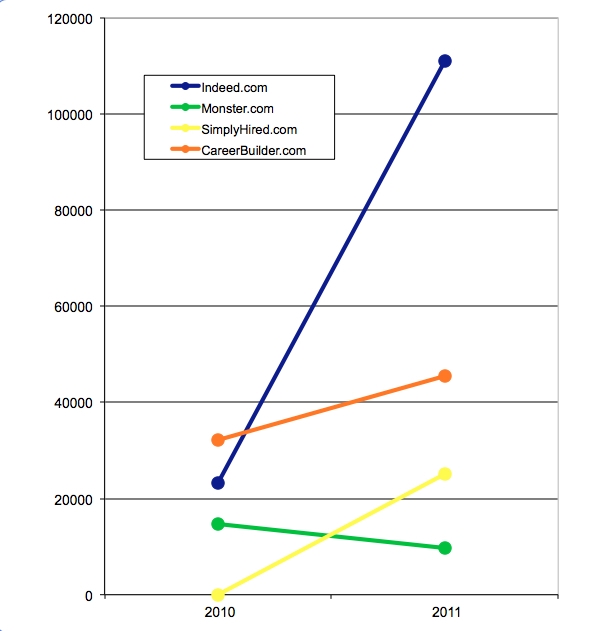
Job aggregators seem to be performing the best this year, but it’s an incredibly volatile market/industry and it’s hard to confidently predict what will happen in years to come.
CPC campaigns on LinkedIn have been effective for certain kinds of positions, including sales representatives, management positions and some technical positions.
Where is recruitment advertising going next?
There’s talk that mobile is the next platform for recruiting, but online recruitment advertising will still be dominated by job boards, despite what critics think. They will continue to evolve – some boards will grow and others will fade out, but they’re not going anywhere anytime soon. The 377% spike in Indeed is evidence that things are changing fast.
Social media recruitment advertising isn’t gone either – in fact, it just started. It made a big surge in recruiting in 2011. But people are still working to understand how social marketing works and not just for recruiting, but in the B2B and B2C world as well. It’s definitely not going away anytime soon.
And lastly, PPC & CPC recruiting campaigns are also in focus for 2012 and beyond. It’s proved to be a great alternative way to target and attract candidates.
Where do you think recruitment advertising is going? What are the best forms of online recruitment advertising for you? Leave a comment below and share your thoughts.
NewHire offers a variety of recruitment advertising packages including Sponsored/CPC campaigns, social media, and top-performing job board packages. To learn more about our recruitment advertising, click here.


