Social recruiting is becoming increasingly prevalent with companies, surpassing the use of traditional recruiting. Social recruiting is defined as recruiting candidates by using social media platforms. Popular social media sites that are used for recruiting include LinkedIn, Facebook, Twitter, Google+, Branchout, Viadeo and XING. These social sites can be used to effectively source out candidates.
So the big question is why should recruiters use social recruiting in addition to traditional recruiting? One of the biggest reasons is the enormous reach that social media has today. According to Statista Facebook, Twitter and LinkedIn are the top three social media platforms today. Facebook has 936 million daily users, Twitter has 300 million monthly active users and LinkedIn has 364 million members.
According to a study done by Jobvite here is the breakdown of the number of jobseekers using social media platforms for their job search activities.
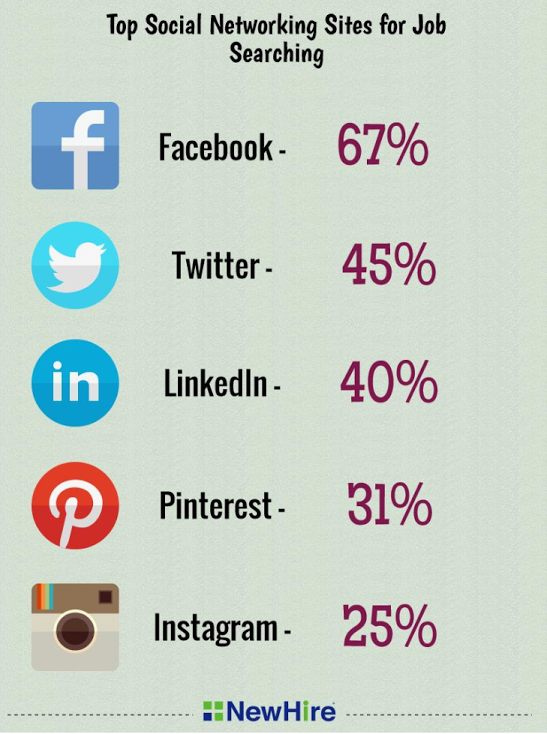
Other important reasons to use social recruiting along with traditional recruiting is social recruiting can focus on multiple goals at one time as traditional recruiting has only a single focus. In addition, there are multiple benefits that social recruiting will provide for an organization that traditional recruiting will not.
Social Recruiting Benefits:
1. Find Quality Candidates
Social recruiting will allow you to connect with the potential candidate and get to know them better through social media. For example the type of content and tweets that the potential candidate posts will give you a glimpse of the candidates personality, interests, industry knowledge, etc. This will give the recruiter some foresight to see if the candidate may be a good fit with the company culture.
2. Build a Great Company Brand
Social recruiting can build your company brand and foster a great reputation. Twitter will allow you to boost your brand visibility by engaging with jobseekers through tweets and post positive information about the company which will promote a good reputation. On Twitter your company can share links from your company blog which will provide great insight to the jobseeker on your company culture and industry news. Facebook can provide the candidate the opportunity to see how you interact with customers regarding your products and services. LinkedIn can provide the potential candidate the opportunity to actively participate in industry group discussions which will give them great visibility to recruiters. A person who is social media savvy can be an attractive candidate to a company which the company can envision the potential candidate helping the company brand by contributing to sharing posts and spreading the word about the company’s philanthropy and company initiatives that affect the industries they work in and communities they serve.
3. Help Establish The Company Mission / Promote Company Culture
Social recruiting can bring additional benefits to your organization by helping establish the company mission and promote your company culture. Experienced and educated job seekers tend to place a high importance on a company’s mission. Therefore, if you want to attract the best talent your company mission must be attractive and compelling for a job seeker to want to join your team. The job seeker also must feel like they will fit in well with your company culture. The potential employee will want to feel comfortable in an environment in which they are able to thrive in and successfully contribute to fulfilling the company goals.
What is the future of social recruiting? With social networking being increasingly prevalent users have become both consumers and content producers which will create a higher level of engagement between users and companies. With this higher level of engagement companies and recruiters will need to provide more robust company profiles along with employment opportunities online. To be successful with this new form of recruiting companies and recruiters will have to increase their online presence. This will change your recruiting strategy tremendously. Recruiters will need to switch to an ongoing commitment to recruiting instead of sporadic recruiting practices. This will catapult many recruiters into an entirely new era of recruiting which will change the way you approach recruiting forever.

 The goal of any recruiting process is to select a candidate who is likely to be effective on the job and contribute to the company’s overall success. While that sounds easy, if you are an owner of a small or mid-sized company, an HR professional, or a manager, and are responsible for recruiting and hiring, it’s likely you’ve experienced stress as you move through the recruiting process. Chances are good that there are several steps you take to learn about the candidate and predict their future success. One of the tools that many companies, recruiters, and HR professionals use are assessments.
There are several types of assessments available in the marketplace. Assessments fall into three general categories:
-
Skills assessments – the goal of these tests is to uncover whether or not the candidate has the skills to perform the duties required for the job. Skills can range from typing or data entry speed, to knowledge of programming languages, sales skills, or other technical skills like welding or operating various equipment.
-
Cognitive abilities tests – the goal of this test is to uncover the candidate’s ability to learn, apply logic, and to assess reading comprehension, math skills, and general knowledge.
-
Personality assessments (including behaviors, motivators, values or integrity etc.) – the goal of these types of assessments is to learn about how the candidate will interact to others, respond to stressful situations and determine if a candidate will fit in with the culture of the work place and the demands of the job.
You probably use other tools to learn about candidates. These include candidate screeners and interviews. Candidate screeners are often part of the initial application process. Depending on the system used, a screener might include questions about skills, work experience, salary, and even work behaviors like travel and work schedule. Interviews, when done well, can shed light on the personality, values and skills displayed by the candidate.
It’s important to use assessments in a way that will improve the likelihood of selecting a candidate who will succeed on the job. A recent article in Entrepreneur put it best by saying, “A behavioral assessment is only helpful if you understand what behaviors would be successful in that particular job.” If you don’t know what behaviors will lead to success, implementing this type of assessment won’t help achieve the goal.
There are three powerful ways to use assessments:
-
Use an assessment that will illuminate characteristics or proficiency you would like to know about the candidate. If on-the-job success is dependent on a specific skill set, choose an assessment for those skills.
-
Use a high quality assessment. Most high quality assessments are validated. Validation means that research tools were used to gather data to demonstrate that the assessment measures what it claims to measure, that cultural bias is not a factor in the results, and that the results are reproducible. Also consider cautionary information expressing ways that the test should not be used.
-
Use the assessment results as one factor in the decision making process. It is easy to imagine that excellence in a single skill or behavior might carry a candidate to success. Serious shortcomings in other areas can be devastating for on the job performance.
According to an article in the Harvard Business Review, which discussed academic research on this topic, the assessments which correlate best with employment success includes multiple measures, “cognitive ability, personality and interests.” For example if data entry speed or typing speed is important, candidates should be asked to take a typing test. And if customer service attitude is important choose a behaviors and motivators assessment that uncovers how a candidate will respond to others. If the job requires logical thinking and an ability to learn new information quickly, try a cognitive abilities assessment. Gathering a variety of information that is important for success will help prevent bad hires.
During the recruiting process take steps to find out as much as you can about the candidate’s skills, experience and behaviors to predict their future success. Use a combination of information to make a smart hiring decision and to mitigate the risk. Choosing an assessment that’s right for the job, could mean that you are using a skills assessment, a cognitive assessment or a personality assessment, depending on job requirements. Use a combination of assessments including screeners and interviews. Sounds easy, right? But remember that it’s also important not to alienate candidates by prolonging the pre-employment process or by asking them to take so many tests that the feel like a guinea pig instead of a valuable prospective employee.
As a kid, the phrase “Don’t put all of your eggs in one basket!” always stood out to me as kind of silly. The idealist in me said, “But if they’re all in one basket, then I can carry them all at once.” And, yesterday, as I stood looking at a dozen shattered eggs sprawled out over my kitchen floor, the idealist in me was very, very silent.
I don’t know if I’ll start keeping my eggs in more than one carton, but at least now the essence of the adage is not so lost on me. Especially when it comes to your business, employees, or products, having a back-up plan is essential for those things in life that are difficult to replace. As careful as you are in everything you do, at some point, you’re bound to drop a carton of eggs on the kitchen floor.
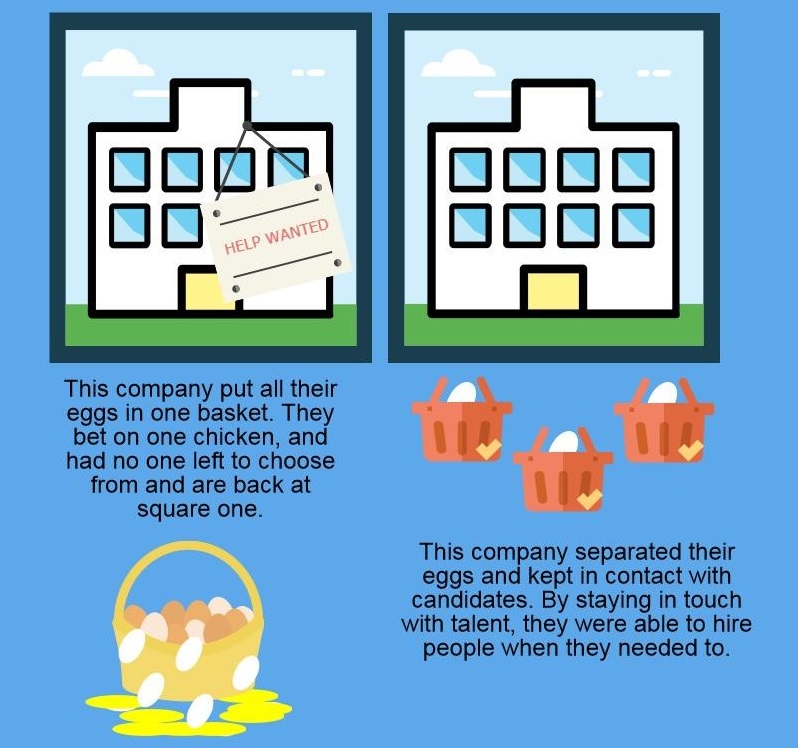
The place in the recruiting process where most employers forget to diversify is during the final offer – Step 6 in our 6 step recruiting process. A business has done all the up-front work necessary. That includes developing a compelling Employee Value Proposition, writing a great recruitment ad, and assessing the candidate pool adequately. They bring in some fantastic candidates, interviewed them, and found a few that fit the position and company culture. Finally, they choose one. What now? The business sends an offer letter to the top candidate, and when that candidate accepts, the business forgets about the other great talent they just spent months trying to find. Or maybe if the HR Manager is feeling polite, he or she sends the top few candidates an email that says, “Thanks but no thanks, we’ve filled the position.”
Perhaps you see where this is going. Top Candidate starts on day one, picks things up pretty quickly and is enjoying the company after a few weeks of working there. But then Top Candidate gets a call from her last employer. After some groveling, and a tremendous salary increase, Top Candidate goes back to her old company, and we are left standing in a pile of egg yolks.
In sales, a company would never let a qualified prospect off the hook because they found another qualified prospect to sell to. So why do we throw away good talent so quickly? Especially given the understanding that retaining great employees is so difficult, why throw all of our eggs in one basket?
That moment when your top candidate accepts an employment offer is a wonderful moment. Especially for a business that’s been searching to fill this position for a few months, or even a few years, it can be liberating. But it is also a crucial moment in the hiring process, and one that most small businesses can’t afford to get wrong.
Keep a clear head and check your optimism. Take the good talent you found during the first 5 steps in the hiring process, and just like you would in sales, continue to engage with them. When good talent comes around, remember that “not now” is always better than “no.” A great way to express this to a candidate is as follows:
“We hired a person for this role, but we are always looking to add great people to our team, and throughout the interview process we recognized that you are immensely talented. We would love to add you to our team once we have the capacity to bring on more people. Would you mind if we stayed in touch over the next few months to see if we can do that?”
Imagine hearing that kind of a “no” as a job candidate. The worst the candidate could say is that he or she does not want to hear from you, in which case you are no worse off than you were before. A recruitment process that works like a sales process ensures that once you’ve found good talent, you don’t let them off the hook until they give you an absolute, definite, no. This way, you’ll never be left standing in a pile of cracked eggs with a recruiting emergency on your hands, and your company will continue to add great talent with every hire.
Things are going great. Candidates are flowing in everyday and you are sorting through as they arrive. Two weeks have now gone by and the traffic is starting to fade. You think, “Oh no!! But I haven’t found the right person yet!” Nothing to fear, you just need to re-advertise! It costs money to find the right person, but in the end it will pay off when you fill an important role in your company.

There are a couple of reasons why you might need to re-advertise, and once you discover that reason, you should consider the best times to actually do the re-posting. It’s not always a quick fix – so you should also consider patience a necessary virtue during this time. Take the time to understand what might need improvement to attract a great pool of candidates.
Here are some reasons and solutions you might need to re-advertise:
1. You’ve advertised, but candidates eventually stopped applying.
Candidates look at new postings first. As your ad ages, it will generate less traffic as newer jobs are being posted. Additionally, your sponsored budget runs out, or your job board posting could have expired. It can be effective to repost to bring your job up to the top and to attract fresh attention for candidates.
Time to Re-Post: If you really need more people, consider re-advertising two weeks after the initial posting – if it is a sponsored budget, start a new campaign as soon as the previous runs out. It is also an option to run an ad on one job board at a time to save money in case you come to find a job board isn’t working. This way you can focus your spending only on what is working.
2. You didn’t get many candidates.
If this happens, you might re-examine your job ad to make sure there is an attractive employee value proposition, compensation listed, and detailed job duties. Your job title might also have an affect on your candidate pool. If your title is too specific, it might be more difficult for candidates to search on. You should also watch out for labeling your job too generically such as a customer service representative, when you really want someone with advanced subject knowledge and extended experience. Also examine the market of the industry to see if it is a good time to advertise.
Time to Re-Post: Take the time while your current advertising is running to re-work the job ad and try an alternative job title.. Get expert help on the compensation range if you’re unsure, then develop a solid employee value proposition. Once you’re ready with this, re-advertise or update your current ads to reflect your changes.
3. The person you hired didn’t work out. It happens.
Sometimes the candidate changes their mind about the position or thinks they are not a good fit. When this happens, especially when they held a vital role in your company, you need to revamp your recruiting to search for the right person
Time to Re-Post: If it’s an immediate need in your company, start advertising right away. See a recruitment expert at NewHire to get you up and running. Take a day before you advertise, to look at your ad once more to ensure you are attracting the right qualified candidates to your job.
Has your company experienced any of the situations above? Let NewHire help you get back on track and set you up with a job ad constructed by an expert and a wide range of advertising options. Just remember, every job deserves the right person!
A NewHire Case Study
Imagine the chaos you would encounter if every regional and site manager in your food service management firm could order their own ingredients from any source they chose. Duplicate product, missing product, variable quality and no profit would be the the result, right? Food service providers strive to create, implement and monitor systems to avoid the chaos of everyone “doing their own thing.”
Yet when it comes to hiring staff, many food service management companies force managers to “do their own thing.” This happens when hiring managers are told to run an ad, screen, interview, hire and on-board people without support or structure from the organization.
Quest Food Management Services was faced with similar issues when they turned to NewHire for help. From candidate chaos, Quest organized their recruiting so that 3,336 people applied to 116 jobs titles, ranging from Food Service Worker to Human Resources Director, and Lead Line Cook to Vice President of Operations. Now everyone uses the same system and the same process.
Recruitment ad purchases were streamlined and measured for effectiveness. Managers were the given tools they needed to recruit talent and are now held accountable for the results.
Our Quest Food Management Blog Series:
Part 1: Overview
Part 2: Analytic Results Infographic
See the detailed results of Quest’s recruitment for 116 jobs.
Part 3: A Professional Case Study
To recruit for the essential Vice President of Operations role, Nick Saccaro, Quest’s President, chose NewHire Professional.
Part 4: NewHire Advantage- Conclusion
For the bulk of the 116 positions, Quest’s managers recruited, screened and hired candidates with NewHire Advantage.
Want to learn more about how NewHire can help your company hire better? Request a demo here, or give us a call at 877-923-0054.
As Quest Food Management Services of Lombard, IL has discovered, NewHire’s Advantage recruitment solution is an ideal fit for a rapidly growing food service management company. For over a year, Quest has successfully used NewHire’s Advantage service to continually recruit across the region and across the company’s diverse range of open positions. Advantage is not only the regional management team’s recruitment software, housing candidate’s applications, sorting out those who match the company’s qualifications, and allowing Quest to easily tag, track and share candidates. More importantly, Advantage is the team’s recruitment process, complete with expert help as needed.
NewHire’s Advantage service is well suited to the good, bad and the ugly of food service management recruitment. That’s true not only for the seasonally-driven K-12 market, but for food service management companies (FSMCs) serving higher education, business and industry, healthcare, senior and corrections clients. As a FSMC, you need to hire quickly, for many different job titles and dozens of positions, in a short time frame. If you are working in the education market, you may need to hire again after the first school or semester break, to recover from mid-year attrition. You need to hire for a wide range of positions: regional management and sales roles, corporate positions, food service directors and perhaps most importantly, the food service workers who interact daily with your clients.
Here are just a few of the ways NewHire’s Advantage can organize food service recruitment into one ongoing process for all of your job titles, positions, regions and client facilities.
One cost effective process, for everybody.
Advantage offers you unlimited users and unlimited job titles. From one dashboard, all of your staff involved in hiring will be able to post jobs, create applications that accurately screen applicants according to your requirements and priorities, and search for, sort and select candidates. We’ll get you off to a good start, too, with the attention-grabbing ads for your first three job titles written by our recruitment experts, and three ad packs provided to you at no additional cost.
No more unqualified resumes. And no more stacks of any resumes.
Our powerful screening tools help you easily identify candidates who match the qualifications you define for each job. NewHire saves you hours of time spent reviewing unqualified resumes, and with custom applications and screening questions for each job title, allows you to instantly sort candidates based on the qualifications you consider most important, so you’ll never have to print another stack of resumes for review. You can tag and track candidates, make notes, and share candidates with other users right in the software.
What sets your company apart – right there in your ad.
We’ll work with you to articulate what differentiates your jobs and your company from others in the business, and talk with you to clearly understand what makes your FSMC a great place to work. Then we will build that great company image – that Employee Value Proposition that makes your jobs great opportunities – right into NewHire, so it’s front and center for every applicant.
Client service and specialized expertise just like you give to your clients.
We know that food service management providers know and value good client service and the coaching and guidance that only experts can provide. We do, too. When you choose Advantage, you’ll be assigned to a recruiting professional who will work with you throughout the hiring process. We will also provide training for your entire HR team, and additional phone support, on-demand, when you need it.
Read about the recruitment results the Quest Food Management Services team has achieved using NewHire Advantage here and about their experience using NewHire’s Professional solution to successfully hire the right person for an essential executive position here.
Still not sure Advantage is the right fit for your organization? How about a cost-effective trial run? Check out our Elements solution. Elements offers you all of the services of Advantage for a single job title. Try one job title, for as many people as you need to hire in that role, and judge by your own results.
Our Quest Food Management Blog Series:
Part 1: Overview
Part 2: Analytic Results Infographic
Part 3: A Professional Case Study
Part 4: NewHire Advantage- Conclusion
Want to learn more about how NewHire can help your company hire better? Request a demo here, or give us a call at 877-923-0054.
Our Quest Food Management Blog Series:
Part 1: Overview
Part 2: Analytic Results Infographic
Part 3: A Professional Case Study
Part 4: NewHire Advantage- Conclusion
Want to learn more about how NewHire can help your company hire better? Request a demo here, or give us a call at 877-923-0054.
Quest Food Management Services in Lombard, IL recently utilized NewHire Professional services to hire for their essential Vice President of Operations role. The NewHire Professional service includes NewHire creating the customized advertisement and the screening questions, filtering for qualified candidates, conducting the initial phone screening of the applicants, and handling all of the interview set up and subsequent process follow-up. This full service model was right for Quest’s recruiting efforts for the Vice President position because it assigns the bulk of the work to NewHire, while providing a consistent and dedicated partnership between NewHire and the client.
Our work with Quest’s President Nick Saccaro before the advertising campaign was created was strategic, focused and comprehensive. We spoke with Nick to establish a clear understanding of the Vice President of Operations role, as well as the type of individual that would be best suited to the role, and to the corporate culture. Quest was hiring for an excellent opportunity that met or exceeded similar  positions in the industry and it was critical to highlight the unique attributes of the role. Once these priorities were established, we were able to craft an advertisement and application questions that targeted the type of high level candidates who would succeed in the role. As a result of the thorough preparation done at the start of the process, the position received a total of 233 applicants, allowing Nick the opportunity to speak to a variety of candidates.
The NewHire Professional service is well-suited to executives who are short on time or experience to do the bulk of the recruiting work themselves but it is even better suited for those who can make the time to be involved and are committed to the recruitment process as a whole, especially for key positions. Despite Nick’s extremely busy schedule, he was dedicated to the process and focused on our continuously driving the process forward. He spent time searching through the NewHire software to identify candidates, utilizing the sort and search filter to save time, then he prioritized interviews in his schedule, and gave quick feedback about candidates. As a result, Nick spoke to the candidates that he wanted to speak with, and made the decision to hire within 4 months of advertising.
The NewHire Professional service is not a quick fix solution, and it should not be. We understand the immense need for the right person in key roles. NewHire Professional is for those who are looking for a supportive partner who will be there during all phases of this significant search.
Our Quest Food Management Blog Series:
Part 1: Overview
Part 2: Analytic Results Infographic
Part 3: A Professional Case Study
Part 4: NewHire Advantage- Conclusion
Want to learn more about how NewHire can help your company hire better? Request a demo here, or give us a call at 877-923-0054.
The last time I wrote about referrals, I hit you with the truth-stick of unlying. Despite all the studies, testimonials, and anecdotes about how amazing referral hires have been for companies, referrals are not magically superior to candidates you get through traditional sourcing methods. The real reason referrals are higher quality hires is because they go through the kind of thorough recruiting process that ends with quality hires. Good systems lead to good results.
It’s the process, not the source of the candidates, that delivers great hires to your company. When employees enter referral mode, they morph into hiring gurus. They source their network for qualified candidates. They evaluate personalities and compare it to their company’s culture. They sell their friends on the idea of working at your company. These are the bases that every company should be covering in their recruiting process, and the employees that are delivering the best referrals are doing this instinctively.

You’re probably spending thousands of dollars on job boards and recruiters to find qualified candidates, yet you have an untapped fountain of mini-job boards and freelance recruiters coming into your office every day. If you haven’t thought about your employees that way, now is the time to start. There’s nothing that job boards are doing that your employees can’t do as well.
CareerBuilder lets you narrow your search by location – your employees can do that. LinkedIn lets you send unsolicited messages to qualified candidates – your employees are free to reach out to their contacts with that same message. Craigslist gets a bunch of resumes delivered to your inbox – your employees can tell their friends how to get their resumes to you. The point is that you’re not losing any kind of control or functionality by including your employees in your hiring process, so use them.
If you’re going to get this started, you need make sure you cover these steps.
1. Let your employees know that you’re hiring.
The team shouldn’t be surprised when Bob shows up on the first day and needs help figuring out where the coffee machine is. You should start the referral process the same way you start the recruitment process: with a job description and a list of requirements. Make an announcement that lists the position and qualifications, and actively request that your employees consider who in their network is a good match.
2. Reward their effort.
Money is the best way of doing this, but information is a close second. Keeping the employees who are participating engaged in the process with updates and feedback can go a long way towards making your employees feel like they were rewarded for their action. Even if you decide on someone who wasn’t their referral, your employees will still appreciate the feedback and honest effort to include them in the hiring process.
3. Make it easy for your employees and their referrals to find the job.
Social media is king when it comes to sharing, so don’t be afraid to use all your social channels — LinkedIn, Facebook, Twitter — to share job postings with your employees, who in turn, can share it with their own network.
Having a formalized referral process isn’t a replacement to traditional sourcing methods. It’s just another tool for you to use to maximize the visibility of your open position, and it needs to be used alongside your job postings on CareerBuilder, Indeed, etc. When the goal of a hiring process is to find the right person for your job, you can’t just rely on one method or one source for candidates. You have to cast a wide net to get as many people into your pool, so that you improve your chance of finding the best person for your job.