



Archives For Recruiting ROI

http://www.flickr.com/photos/76029035@N02/

Strong interviewing skills can mean the difference between finding your next star employee and making a bad hire. The pressure is on and the interviewer can be as nervous as the interviewee! The interview is your best opportunity to find out if a candidate who looks good through the initial screening process, will be a positive addition to the team. Here is the wisdom gained from more than 20 years of experience interviewing candidates. We learned it the hard way, so you don’t have to.

Before the Interview – Prepare

When the interviewer looks good during the interview the company looks good too, so prepare for the interview and put your best foot forward! Make an interview game plan, and coordinate with everyone who will be interviewing the candidate.

Start by reviewing all available information, including: the candidate’s application, resume, notes from the phone interview and assessment results. Review the job description, too. Next, prepare questions relating to experience, work behaviors, future goals and key accountabilities. Don’t forget to ask questions about significant items like accomplishments, gaps in employment, special skills, leadership activities and hobbies. And remember — some questions are ILLEGAL to ask. Click here for a list of topics that could get you into hot water. Make some notes to use during the interview, especially if you don’t interview very often.

During the Interview — Ask then Listen

Begin with an introduction and a handshake. This sounds obvious, but a warm greeting can go a long way to ratcheting down everyone’s nerves, which will result in more candid responses from the interviewee. Don’t forget to make small talk, ask about the drive to the interview, last night’s unbelievable hail storm, the ball game, or the American Idol competition.

Start the interview using the resume and your notes as a reference. Some interviewers like to ask about every position on the resume. Try it and see what you learn. You might ask the candidate to relate what their supervisor would report as their strengths and weaknesses. This will give you the chance to assess the candidate’s self-awareness, as well as their strengths.

Ask open-ended questions; avoid those that can be answered with a Yes or No. Situational and scenario-based questions are a great tool. Ask questions that begin, “Tell me about a time…” Wait for an answer. Don’t be afraid of silence!

When it’s time to end the interview, ask if the candidate has any additional questions. Be honest and forthcoming about the company and the position as you answer. Surprises can hurt both you and the candidate in the long run. Thank the candidate for their interest and for taking the time to come in for an interview.

Final Thoughts

The goal of an interview is to get an in-depth knowledge about this person’s background and work history, but you are also trying to get a feel for this person’s character, work behaviors and attitudes. Here are some cues and clues to watch for. Does your interviewee:

  • Maintain eye contact and show enthusiasm?
  • Have good communication skills answering questions clearly?
  • Avoid tough questions by changing the subject?
  • Demonstrate respect and friendliness?
  • Pay attention to what you are saying?
  • Use negative language when talking about past employers?
  • Show engagement and interest in the position and the company by asking unscripted questions about what you have said?

Additional resources:
1. An Interviewing Guide: What You Can and Cannot Ask
2. Interview Tips

job gauntlet

The best performing job ads sell both the company and the open position to potential candidates, attracting a strong response and a solid pool of qualified candidates. Our experience and data consistently show that the best performing job postings – those which provide the greatest number of qualified candidates – have a clear value proposition for applicants. The employment value proposition is a statement that answers these two questions:

  • Why is this company a good place to work?
  • What are the interesting and attractive duties and responsibilities of the open position?

When you include this kind of information about the open position and company, your ad will stand out to job seekers. But one look at the majority of ads on any of the major job boards tells a different story.

Here are two examples of poor advertising strategies that are running on major job boards at this time:

  • In one ad, the company description consists solely of “a fast-growing, dynamic company seeks a…” and then lists all required qualifications. If all a candidate knows about a company is that it’s fast-growing and dynamic, then they become meaningless adjectives and it can be a turn-off to people looking for a rewarding position at a good company.
  • Another ad listed 17 “must-have” qualifications immediately followed by this phrase: “A criminal background check (both state and federal) WILL BE PERFORMED before a hiring decision is made!” Emphasis on that many qualifications immediately followed by the threat of a background check conveys distrust in employees and a hostile office environment.

These types of ads conjure images of employers scrambling to develop foolproof gauntlets of “musts and must nots” to deter people from applying. While this may sound familiar, it’s not a best practice for attracting top talent.

If you’re currently using the gauntlet method to prevent unqualified applicants from applying to your job, stop! When you screen and identify qualified candidates using application questions, there is no need to use the classified ad to deter people from applying. In fact, the opposite applies. Use the classified ad as a sales and marketing tool and feature the best aspects of open position. In short, sell your company and your job.

If you’re writing the ad yourself and you’re unsure of where to start, we’ll make it easy for you. We have designed this fill-in-the-blank Job Ad Mad Libs® as a guide to the elements which help set your recruitment advertisements apart from those that use the gauntlet method.

http://www.flickr.com/photos/76029035@N02/

The simplest piece of advice we can give to customers starting their recruitment process is give your job a common name.  Most job seekers are going to search for the most common titles related to the job they want, so you want to make it easy for them to find yours. A good way to test this is to go to a internet job board and search for the title you would like to give your job; if nothing comes up you know you don’t want to use that title.  A general title can attract applicants who feel like they have the skills and ability to do the job, even if they’ve never held a position with that same title before.  This gives you a larger qualified candidate pool with people who can do the job but may not have had a specific job title.

In a recent report from CareerBuilder & EMSI, they found that hiring mangers who screened for the same job title in a candidate’s work history were 31% more likely to say they were having trouble filling a position than hiring managers who didn’t.  Because that latter group of hiring managers was able to look past job titles, they ended up evaluating candidates on the only criterion that actually qualifies someone: skills.  And when you set up your recruitment process to identify skills, you’re going to find more qualified candidates, regardless of their past job titles.

A contributing factor to this “job title fallacy” boils down to a trend in businesses over the last couple of generations to eliminate on-the-job job training. On-the-job training used to be a fundamental part of someone’s work experience.  Hiring managers of the past would look for aptitude to qualify a candidate and whoever they brought on was expected to learn what they didn’t know.  And for the most part it worked.  Sadly, job training has gone the way of pensions and gold pocket watches. Employers expect candidates to bring all the skills and knowledge with them, not learn it on the job.  A matching job title in a candidate’s past is as “good” a cue as any to hiring managers that whoever they bring on will do just that.

Herb Greenberg, CEO of Caliper Inc., tested the theory that you could fill positions without factoring in past job titles.  In fact, he took a step further and threw out a bunch of traditional criteria that hiring managers use, like education and work experience.  He used workplace personality assessments to place 4,000 “hardcore unemployed” people in jobs that he matched to their skills.  Two years later, less than 3% of those who had been placed had been let go for an inability to do the job.  How’s that for skills paying the bills?

The point here isn’t that hiring managers need to do away with traditional screening methods.  For the most part, those methods successfully filter out the candidates who would not be qualified for the position.  However, methods like screening for job titles is just a shortcut to the real criteria that hiring managers want: skills.  You don’t need to pick one or the other because both methods can AND should be part of your recruitment process.  While the job title criterion can help you fill the lion’s share of your candidate pool, a skills criterion can catch the qualified candidates that you missed on the first pass.

“What’s the best job board to publish my job ad?”

We get this question often at NewHire so we keep track of which job boards are referring the most job seekers and how they stack up against one another.

Over the past 15 months, we’ve published over 1100 online job applications for small and mid-sized companies around the US. We took a sample of those 1100 jobs and examined 169 that were advertised on each of the following job boards simultaneously: CareerBuilder, Craigslist, Indeed, SimplyHired and LinkedIn.

We then looked at how the job boards performed relative to one another. This graph shows how many job seekers viewed each job ad from each of these major job boards.

top job boards 2013

As you can see, Indeed is by far the winner. This data included both organic and sponsored ads on Indeed.We saw Indeed’s popularity take off in 2011 and it’s been growing ever since. Because of Indeed’s growing popularity, we recommend publishing all job ads on Indeed, and offer additional sponsored advertising for added exposure. Indeed is beating all the other job boards for bringing in the most candidates.

In fact, Indeed doubles the number of candidate referrals attracted by LinkedIn, SimplyHired, Craigslist and CareerBuilder COMBINED. Take a look:

Job Seekers

It’s obvious that Indeed is killing it in the job board world. But there’s a few important things you need to know:

  • Don’t put all of your eggs in one basket. Just like you should have a diversified investment portfolio, you should also have a diversified recruitment advertising plan. We saw Monster.com, previously a staple in the job board industry decline in popularity so much that the cost for the job ad was no longer justifiable. (Subsequently, we stopped providing their ads.) If you post your job ad on only one job board, you’re limiting your candidate pool, and missing out on a lot of great potential talent.
  • Quantity doesn’t always mean Quality. Yes, Indeed brings in the most candidates, but they might not all be equally well qualified. Don’t neglect industry job boards or referrals from current employees or other people in your network.
  • The good die young. Even though Indeed is the most popular job board right now, I can almost guarantee it won’t be forever. MySpace was also the most popular social network for a while… and we saw what happened there, and that didn’t take too long. The same goes for Monster.com.

Want to keep up on more of recruiting advertising and hiring tips and trends? Get our newsletter!

frustrated

There are some questions and concerns that we see repeatedly with our clients when it comes to hiring. We’re putting together a 5-part series to address the top reasons why small and mid-sized businesses have a hard time hiring. Up first – building candidate pools!

Question 1:

“We are having a hard time hiring for this position — hardly any candidates are applying! How do we do get more people to apply?”

You’ve been advertising the job and hardly anyone is applying. You’re probably right to be worried. There can be a few different reasons that no one is applying. Here are 4 possibilities:

1) The job title is unusual or uncommon.

In the world of internet job board advertising, candidates need to be able to find the job by searching on keywords. If the job title is unusual or doesn’t reflect the duties or salary being offered, appropriate candidates might not be finding the ad. Start by researching what the job titles other companies are using for similar positions. Use CareerBuilder or Indeed to search for similar jobs, then make the appropriate change to your job title.

2) The job isn’t competitive in the market place.

The salary, wages, or benefits offered aren’t competitive with those offered for comparable jobs. Candidates might not be interested if the job isn’t attractive. Make sure your salary and benefits are competitive.

3) Talent is scarce for the position.

If you’re looking to hire a highly-specialized engineer for your company based in Small Town, Wyoming, you may find that the available local talent pool is more limited than it might be in a major metropolitan area. If that’s the case, you might have to hire and relocate talent from outside the geographical location. You might also be able to attract top local talent with strategic incentives.

4) The job advertisement is not attractive.

It’s a great job at a great company, but the recruitment ad copy doesn’t highlight the best aspects of the job. In this case, you need to develop a strong employee value proposition to better articulate why your company is a great place to work and express why this is a great opportunity for candidates. Use that employee value proposition in your recruitment advertising.

If you’re not able to assess and address these problems within your company, you may need some outside help to solve the problem.

Do any of these challenges sound like things you’ve experienced? What are you doing about it? 

linkedin

LinkedIn is becoming a great place for candidates to search for jobs – earning their reputation as the “world’s largest professional network.” We have been experimenting with the effectiveness of using the “share” button to spread the news about job openings with our clients. Our data found that the more people who share your company’s job, the more exposure it will get.

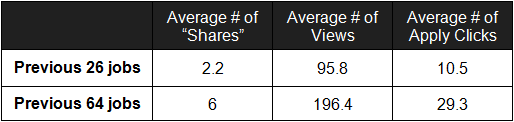
Taking a sample of 26 jobs posted on LinkedIn (from 8/20/12 to 9/20/12), with an average of just 2.2 shares per job, we saw an average of 95 people viewing each job.

However, taking a sample of our 64 jobs (from 6/20/12 to 9/20/12) we had an average of just over six shares per job and an average of 196 views for each job that was posted. Additionally, the first set of data average just over 10 apply-clicks per job, whereas the second averaged 29.

LinkedIn Share data

The data show the number of apply clicks and views is directly correlated to the number of shares.

Types of jobs that don’t draw well with social media advertising

Obviously there are factors outside of how many times a job is shared. The job itself is paramount: A bad job won’t get candidates even if everyone knows about it (everyone will just know it’s a bad job). Another factor is what type of job you’re posting on social sites. Typically, blue collar jobs or hands-on jobs will not draw as well on the internet. The same goes for face-to-face jobs like waiting tables and bartending. The reason for this simply stems from the type of person who is being searched for – an employer must know who the ideal candidate is in order to know how to reach that person.

Types of jobs that do draw well on LinkedIn

We’ve found that management-level positions advertised on LinkedIn tend to do draw well. The reason could simply be that management-level employees understand the importance of having professional networks, and thus use the website regularly. In addition to administrative positions, which are wildly popular everywhere, the most commonly applied for position level was management.

Sales positions have also performed well on LinkedIn as it is a rapidly changing/moving industry, and those candidates are prone to using professional networks to connect with prospects, leads and other companies. Sales reps are always on the move and are always needed somewhere. As such, it comes with the territory to stay up on technology and be active in finding new ways to survey the sales landscape. Additionally, sales representatives know that LinkedIn is an effective sales tool. It is useful to find information about a lead before making a call. As such, sales reps are already using the site, so it makes sense that they’re reachable on the site.

Promoting on other social media sites

As far as the other social sites, they are far behind LinkedIn from an employment standpoint. Facebook boasts targeted pay-per-click advertisements and various company-apps for job-searches, but there isn’t a go-to platform to utilize the network. In the same vein, Twitter is good for sharing jobs and telling people that they’re available, but it does not yet offer a way of knowing how effective it can be as a job-promotion tool.

Takeaway

As you can see, how effectively sharing your jobs on Linkedin has a significant effect on the amount of candidates who will apply for the job. Make sure to encourage your employees to share your company’s jobs as it will extend the reach of each advertisement.

Have you used social media to promote your job ads? How has it worked for you?

Image Credit: http://www.flickr.com/photos/coletivomambembe/

As of April 1, 2012, NewHire no longer provides Monster ads to clients. This brings to an end an 8-year relationship through which we have helped our clients purchase more than 1,600 ads on Monster.

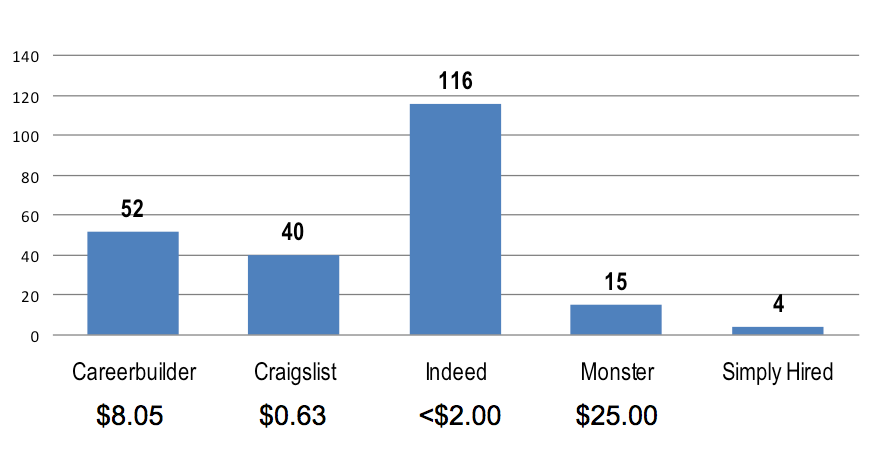
However, our latest data has shown that Monster hasn’t been delivering enough job seekers per ad to justify the cost. The chart below shows the number of Job Seekers per Posting (the number of candidate views generated by each website) and the Average Cost per Job Seeker (the number of candidate views by website divided by the “list” price for one ad on each website).

The chart represents job posting data from 90 open positions from September 2011 to February 2012. The chart also represents the following characteristics:

  • Each position was posted simultaneously on Indeed, Careerbuilder, Monster, Craigslist and SimplyHired
  • The advertised positions represented 15 states, nine industries and four job types
  • Data was compiled from NewHire’s web-logs and verified against Google Analytics

While Indeed and Craigslist yield the most candidates per posting, Careerbuilder continues to be successful delivering a large number of candidate views. SimplyHired is a job aggregator like Indeed, although Indeed is significantly larger. NewHire jobs feed to SimplyHired at no additional charge to our clients, so there is no associated cost-per-candidate.

Indeed, now the most popular job board, attracts the most job seekers, through a combination of no-charge “organic” ads fed to Indeed from NewHire and sponsored cost-per-click ads that feature sponsored jobs prominently on the Indeed job board. We find that Indeed clicks cost employers between 45 cents and $3.00 per click depending on factors like job type and location.

In response to this data, we’ve replaced Monster with LinkedIn job postings to provide our clients the tools to yield the best possible candidate pools.  We’re always keeping careful track and we consider this data when determining the value of our job posting services. We’ll keep you up to date on these results!

help wanted

I had the opportunity to attend the Vistage All-City in Chicago, where Brian Beaulieu of IRT Economics did a presentation on the state of the economy and what it means for Small and Mid-sized businesses (SMBs).

During the presentation, he asked the 500+ business owners in the room if they had hired a new employee within the last year. Nearly everyone raised their hand. He then asked those business owners if they’ve had trouble finding candidates. No one put their hand down.

With unemployment so high, why are so many businesses having a hard time getting the right candidates to apply for the job?

Businesses expect a lot of people to apply for their job openings because there are a lot of candidates in the job market – but many businesses owners are saying that’s not the case. Hiring is a pain, and businesses are having a much more difficult time hiring now than ever before. So why is this?


A company’s ability to attract the right candidates depends on the following factors:

  • Location of the job
  • Available talent
  • Relative attractiveness of the position compared to other similar jobs

1. Where is the job located?
If you are a SMB based in Small Town, USA and you’re hiring for a highly skilled job, it’s going to be harder to find someone for the position – you’re fishing in a little pond. On the other hand, if you’re hiring for that same job in NYC, your chances for finding qualified candidates is substantially greater. Location has a lot to do with how many candidates you can source.

2. How much talent is available?
The Wall Street Journal recently published an interactive graphic showing the unemployment rate for hundreds of job titles. The jobs with the highest unemployment rates were in the trades, manufacturing, and construction. The lowest unemployment rates where in the healthcare, petroleum & nuclear engineers, as well as veterinarians. If you are hiring for a job title with a low unemployment rate (like mechanical engineers with a 2.6% unemployment rate) you will have a harder time recruiting and hiring.

3. How attractive is the job?
If you’re hiring for an Engineering Manager Position at your company, your job has to be… well… attractive. You’re competing with other companies for the same (scarce) qualified people. To attract the right talent, you must be able to offer a better (or at least competitive) employment opportunity when compared to similar opportunities at other companies. A better opportunity can include a variety of factors – higher pay, bonuses, extended vacation time, company perks, work environment, or the opportunity for advancement. We recommend that you explore your Employment Value Proposition (EVP) to help you understand what makes your company’s job a stand-out opportunity.

Here’s Your Homework
If you’re hiring for a position at your company, evaluate each of the factors – location, available talent and the relative attractiveness of the job. While you may not be able to impact either of the first two items, you can make the job more attractive and more competitive. Think about alternative incentives and highlight your EVP.

If your job is unattractive – make it attractive! It is worth the extra expense and effort to attract the right candidates. After all – beauty hurts!

Internet-based recruitment advertising has changed drastically over the last couple years. Talk about changing fast – we’ve seen Indeed.com increase it’s referral visits by 377% in just the last year!  Where it was once sufficient to buy a Monster ad, recruitment advertising is now fractured into a variety of job boards, social networks like LinkedIn, Twitter and Facebook. Cost-Per-Click (CPC) Campaigns are now also competing for your money and the attention of job-seekers.

Online recruitment advertising is changing rapidly. We keep an eye on industry trends and generate reports to help you when considering the best recruitment advertising medium for your next hire.

Job boards are here to stay, but will evolve.

Some would say job boards are declining and fading out, but they still remain the most effective and widely used way to source candidates. Job boards play a role in 45% of new employees. [1]  Massive job board sites like Monster.com have declined in popularity and effectiveness in sourcing candidates, while major job aggregator sites like Indeed.com have really gained momentum.

NewHire gets hundreds of thousands of visitors from referred sites, and we compile the data each year to see which are performing the best, are most cost-effective and produce the most. We had some interesting results this year – here they are:

  • Indeed.com is growing – FAST. We had a 377% increase in referred visits from Indeed since last year – and dramatic influx from 2010.
  • Monster.com is fading. Referred visits from Monster.com decreased 34% from 2010 to 2011. We still receive a good flow of applicants referred from Monster, but it’s decreasing over time.
  • SimplyHired is growing faster than Monster. We partnered with SimplyHired this year and already saw it outperforming Monster by 159% this year alone.
  • CareerBuilder is also growing. Referral visits increased almost 42% from 2010-2011.

job boards

Job aggregators seem to be performing the best this year, but it’s an incredibly volatile market/industry and it’s hard to confidently predict what will happen in years to come.

CPC campaigns on LinkedIn have been effective for certain kinds of positions, including sales representatives, management positions and some technical positions.

Where is recruitment advertising going next?

There’s talk that mobile is the next platform for recruiting, but online recruitment advertising will still be dominated by job boards, despite what critics think. They will continue to evolve – some boards will grow and others will fade out, but they’re not going anywhere anytime soon. The 377% spike in Indeed is evidence that things are changing fast.

Social media recruitment advertising isn’t gone either – in fact, it just started. It made a big surge in recruiting in 2011. But people are still working to understand how social marketing works and not just for recruiting, but in the B2B and B2C world as well. It’s definitely not going away anytime soon.

And lastly, PPC & CPC recruiting campaigns are also in focus for 2012 and beyond. It’s proved to be a great alternative way to target and attract candidates.

Where do you think recruitment advertising is going? What are the best forms of online recruitment advertising for you? Leave a comment below and share your thoughts.

NewHire offers a variety of recruitment advertising packages including  Sponsored/CPC campaigns, social media, and top-performing job board packages. To learn more about our recruitment advertising, click here.